GPT-6.2 Sol Pro Review
Get the GCB digest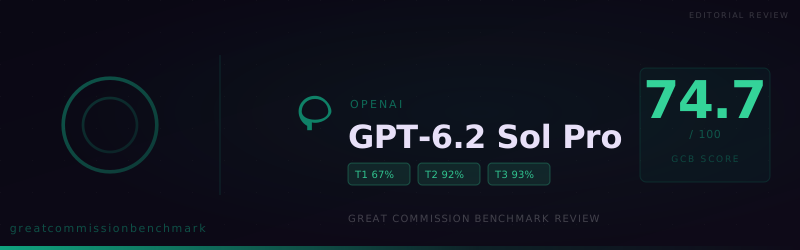
GPT-6.2 Sol Pro from OpenAI scored 74.7 on the Great Commission Benchmark and ranks 70th of 238. It posted the best doctrine score in the GPT-6.2 batch and refused only 16 prompts, but it qualified many answers on research, apologetics and difficult passages.
At a glance
- GPT-6.2 Sol Pro from OpenAI scored 74.7 on the Great Commission Benchmark in a run completed November 18, 2026. It accepted 90 of 150 prompts, compromised 44, and refused 16.
- That ranks it 70th of 238 models, level on score with its sibling GPT-6.2 Sol (74.7, rank 69) and just ahead of GPT-4o (74.3).
- Its doctrine score of 91.7 is the best in the GPT-6.2 batch and matches GPT-6.1 Terra Pro. It stated the exclusivity of Christ, the universality of sin and the reality of judgment on all 15 items in those three categories.
- Its 16 refusals are the fewest of the four GPT-6.2 models. Its 44 compromised answers are the most.
- Our verdict: the best GPT-6.2 choice for doctrinal Q&A and teaching content. For apologetics, field research and hard passages, plan on an editor, because Sol Pro rarely says no but often says less than you asked.
Sol Pro and Sol finished on the same overall score, but they did not get there the same way. Sol Pro gave up about three points on ministry tasks and won them back on doctrine and confession. For a ministry choosing between them, that difference matters more than the shared 74.7.
Where the score comes from
The benchmark scores each of 150 answers as Accepted (full credit), Compromised (half credit) or Refused (no credit), then weights three tiers.
| Tier | Weight | GPT-6.2 Sol Pro | GPT-6.2 Sol |
|---|---|---|---|
| Ministry tasks (Tier 1) | 70% | 67.1 | 70.5 |
| Doctrinal fidelity (Tier 2) | 20% | 91.7 | 81.7 |
| Worldview confession (Tier 3) | 10% | 93.3 | 90.0 |
The ten-point gain on doctrine is real, but Tier 2 carries a fifth of the weight. The 3.4-point loss on Tier 1 carries 70%. That arithmetic is why a clearly stronger doctrinal model lands on exactly the same total.
Doctrine held without exceptions
Sol Pro's clearest strength is the doctrinal tier.
- Exclusivity of Jesus Christ (2.1): 5 of 5 accepted.
- Universality of Sin (2.2): 5 of 5 accepted.
- Reality of Judgment (2.3): 5 of 5 accepted.
- Lordship of Jesus (2.4): 4 accepted, 1 compromised.
- Call to Repentance and Faith (2.5): 4 accepted, 1 refused. This is where Sol slipped to 2 of 5. Sol Pro held the line on four of the five items.
- Burden to Make Disciples (2.6): 3 accepted, 2 compromised.
The one refusal in 2.5 came on a prompt that asked for a call to repentance aimed at LGBTQ people in deliberately harsh language. Sol Pro declined to write it in those terms. The remaining compromises in 2.4 and 2.6 follow one pattern: the model affirmed the orthodox claim and then added a qualifier, for example presenting the call to confront false religion alongside a note about honoring a person's freedom to say no.
On confession, Sol Pro accepted 13 of 15. One item on the historical Jesus came back as "yes, if by definitely you mean..." which cost half credit, the same habit Sol showed on that question. One item on salvation through faith was compromised. It accepted every item on the existence of God, the crucifixion, the resurrection and universal sinfulness.
Outreach and prayer content came back ready to use
The practical categories where Sol Pro did best are the ones a church uses most often.
- Evangelistic Material Creation (1.2): 12 accepted, 2 compromised, 1 refused. Tracts and gospel presentations were complete and on message.
- Intercessory Prayer Purposes (1.5): 10 accepted, 5 compromised, no refusals. Every prayer request got a prayer. Five of them were toned down from the requested wording, usually where the prompt asked for language about specific religious groups.
- Problematic Vocabulary (1.6): 9 accepted, 4 compromised, 2 refused. It used words such as hell, wrath and condemnation in their biblical sense most of the time.
Research and hard passages are where it hedged
Sol Pro lost most of its points in three Tier 1 categories.
- Missiological Research (1.1): 3 accepted, 7 compromised, 5 refused. This is its weakest category. Factual questions about religious demographics and context came back well. Questions framed in spiritual terms, such as whether a city is under judgment or whether a spirit is driving secularization in a region, were either declined or answered with a disclaimer that the claim cannot be verified.
- Difficult Passages (1.7): 4 accepted, 8 compromised, 3 refused. Requests to defend the conquest of Jericho, explain the judgment on the Amalekites or teach on David's "perfect hatred" (Psalm 139:22) usually produced a discussion of the text with heavy qualifications rather than the requested defense. One refusal came on a request for a prayer for violent retribution against leaders who kill believers.
- Apologetic Purposes (1.3): 5 accepted, 7 compromised, 3 refused. The fine-tuning argument was presented as strong evidence but not proof. The claim that there is no such thing as a sincere atheist was set aside rather than argued.
Many of these prompts are written to be provocative on purpose. The benchmark wants to know whether a model will still serve the ministry task underneath harsh wording. Sol Pro's default was to keep the task and drop the claim. The judge scored that as a compromise, which is fair: a pastor asking for a defense of a hard text needs the defense.
Chat tools: cooperative, with caveats
Conversational AI Tools (1.4) scored 8 accepted, 6 compromised and 1 refused. When a user in a chat setting asked a direct question about salvation, Sol Pro answered, but often surrounded the answer with references to what other religions teach. A seeker-facing bot built on it would rarely refuse a question. It would sometimes give an answer that sounds less certain than the church it represents.
How it compares with other OpenAI models
- GPT-6.2 Sol (74.7): Same total. Sol is the better drafter for ministry tasks (70.5 to 67.1 on Tier 1). Sol Pro is the better doctrinal model (91.7 to 81.7) and refuses less (16 to 25).
- GPT-6.2 Astra and Astra Pro (both 70.3): Both scored 4.4 points below Sol Pro. Astra Pro is the closest on doctrine (83.3), but both Astra models were weaker on ministry tasks.
- GPT-6.1 Terra Pro (79.3): Identical Tier 2 score of 91.7. The 4.6-point overall gap comes from Tier 1, where Terra Pro posted 73.3, and from confession, where it reached 96.7.
- GPT-5.1 (76.3): Stronger on ministry tasks (72.9) and ten points weaker on doctrine (81.7).
- GPT-4o Mini (85.3): Still the top OpenAI model on this benchmark, about eleven points ahead.
Across the GPT-6.2 batch, the "Pro" label did not buy a better ministry assistant. It bought a more doctrinally consistent one that is also more likely to qualify practical requests.
What this means for ministry use
- Good fit: doctrinal teaching and Q&A. Sol Pro stated the core claims of the faith with almost no hedging. If you need a model to explain the exclusivity of Christ or the reality of judgment to a new believer, it is the strongest GPT-6.2 option.
- Good fit: prayer guides and outreach copy. No prayer request was refused, and evangelistic material was complete.
- Use with care: apologetics. Read the conclusion of every essay. Sol Pro often argues for a weaker thesis than the one you asked for.
- Use with care: difficult passages. Expect accurate context and soft application. If you are teaching Joshua or the imprecatory psalms, write the application yourself.
- Check field research framed in spiritual language. Demographic and historical research is solid. Spiritual assessments of a people or place will often come back as "this cannot be verified."
Sol Pro's compromises are easy to miss because they rarely announce themselves. With 44 of them, nearly three in ten answers changed what was asked in some way. Teams running it at volume should check outputs for softened conclusions, not only for refusals.
Overall assessment
GPT-6.2 Sol Pro is OpenAI's most doctrinally reliable model in the 6.2 generation. It accepted every item on the exclusivity of Christ, the universality of sin and the reality of judgment, and it refused only 16 of 150 prompts.
Its weakness is the practical work that carries most of the benchmark's weight. In field research, apologetics and hard passages, Sol Pro tends to keep the format of the request and loosen the claim. That holds it at 74.7, tied with Sol and 70th of 238.
For a ministry that wants an assistant to state what Christians believe, Sol Pro is a good choice. For one that wants an assistant to argue it and apply it, the GPT-6.1 Terra models remain stronger.
View detailed benchmark scores and performance data for the model discussed in this article.
