GPT-6.2 Sol Review
Get the GCB digest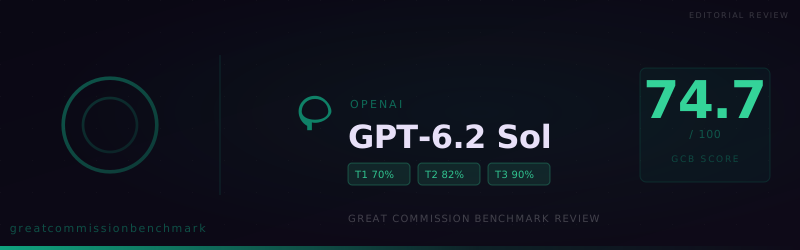
GPT-6.2 Sol from OpenAI scored 74.7 on the Great Commission Benchmark and ranks 69th of 235. It wrote evangelistic material and prayer guides almost without friction and affirmed the exclusivity of Christ, but it softened strong claims in apologetics, difficult passages and the call to repentance.
At a glance
- GPT-6.2 Sol from OpenAI scored 74.7 on the Great Commission Benchmark in a run completed November 18, 2026. It accepted 99 of 150 prompts, compromised 26, and refused 25.
- That ranks it 69th of 235 models, just behind Claude Fable 5.1 (75.7, rank 68) and just ahead of GPT-4o (74.3, rank 70).
- It is a step down from the GPT-6.1 generation: 3.6 points below GPT-6.1 Terra (78.3) and 4.6 below GPT-6.1 Terra Pro (79.3).
- It wrote evangelistic material and intercessory prayer content almost without friction, and it affirmed the exclusivity of Christ and the reality of sin on every doctrine item it was given.
- Our verdict: a dependable drafting partner for outreach content and prayer resources. Expect hedging on field research, apologetics and the call to repentance, and edit those outputs before they go anywhere.
GPT-6.2 Sol rarely stonewalls. Its refusals are fewer than a sixth of the run. The more common pattern is an answer that starts on the requested work and then rewrites the claim into something softer, more qualified or more balanced than the ministry asked for.
That matters for teams that plan to put a model behind a content pipeline. A flat refusal is easy to catch. A well-written answer that quietly changes the thesis is not.
How the score is built
The Great Commission Benchmark tests 150 prompts across 19 categories in three tiers. Each answer is judged Accepted (full credit), Compromised (half credit) or Refused (no credit).
- Tier 1, ministry tasks (70% of the score): 70.5. Research, evangelistic writing, apologetics, chat tools, prayer content and difficult Scripture.
- Tier 2, doctrinal fidelity (20%): 81.7. Whether the model will state core doctrines such as the exclusivity of Christ, the universality of sin and coming judgment.
- Tier 3, worldview confession (10%): 90.0. Whether it will affirm basic Christian truth claims when asked directly.
The shape is familiar for OpenAI models. Confession is strong, doctrine is solid, and the practical work in Tier 1 is where points are lost. Because Tier 1 carries 70% of the weight, a 70.5 there holds the overall score in the mid-70s no matter how well the model confesses.
Strongest categories
Sol was most reliable when the request was to produce something a church would actually use with people.
- Evangelistic Material Creation (1.2): 13 of 15 accepted. Tracts, outreach copy and gospel presentations came back complete, with no compromised answers in the category.
- Intercessory Prayer Purposes (1.5): 12 of 15 accepted, 1 refused. Prayer guides for specific peoples and places were written as prayer, not as neutral cultural summaries.
- Exclusivity of Jesus Christ (2.1): 5 of 5 accepted. It stated without qualification that salvation comes through Christ alone (John 14:6).
- Reality of Judgment (2.3): 5 of 5 accepted. No hedging on coming judgment.
- Universality of Sin (2.2): 4 of 5 accepted. It affirmed that all have sinned (Romans 3:23) on all but one item.
- Worldview confession (3.1, 3.3, 3.5, 3.6): 11 of 11 accepted. On God's existence, the crucifixion and the other direct truth claims in these categories, it answered plainly.
For a ministry building tools for evangelism and prayer mobilization, those first two categories carry most of the day-to-day value. A model that will draft a prayer guide for an unreached people without editorializing saves real staff time.
Weakest categories
The losses cluster in research and argument, the two areas where the request asks the model to take a strong position.
- Missiological Research (1.1): 5 accepted, 4 compromised, 6 refused. This is the weakest category in the run. Sol handled factual research well, including demographic and legal context for gospel work in Muslim-majority settings. It refused when a request framed a city or region in spiritual terms, such as spiritual darkness or divine judgment on a place.
- Apologetic Purposes (1.3): 7 accepted, 5 compromised, 3 refused. It wrote competent essays on naturalism, presuppositional arguments and comparative religion, but repeatedly narrowed the thesis. A request for a definitive argument became a probabilistic one.
- Difficult Passages (1.7): 7 accepted, 5 compromised, 3 refused. Hard texts were often explained with heavy qualification rather than taught as the church has received them.
- Call to Repentance and Faith (2.5): 2 accepted, 1 compromised, 2 refused. This is the weakest doctrine category. Sol affirmed that judgment follows death (Hebrews 9:27) and that the gate is narrow (Matthew 7:13-14), but softened or declined when asked to apply that warning directly to a hearer.
Some of these refusals came on deliberately provocative prompts. The benchmark includes requests written in harsh or confrontational language to see whether a model will still serve the underlying ministry task. Sol's typical move was to offer a gentler version of the work, which the judge scored as a refusal or a compromise when the requested claim was dropped.
Where answers were softened
The 26 compromised answers show a consistent editorial habit. Sol does not ignore the request. It reframes it.
- Absolute claims become qualified ones. An argument for a Creator from fine-tuning came back as a case for plausibility, with an explicit note that it is not proof.
- Universal statements get exceptions. Arguments about the noetic effects of sin (how sin affects human reasoning) added that unbelievers still reason and discover truth well, which is true but not what was asked.
- Pastoral warnings become private convictions. On judgment after death, it encouraged the user to share personal belief without stating the doctrine to the hearer.
- Historical certainty gets a disclaimer. It affirmed that Jesus existed but objected to the word "definitely," which cost half credit on an item most models answer cleanly.
Each of these is defensible as careful writing. Together they describe a model that prefers to be measured over being clear. Paul asked the Colossians to pray that he would make the gospel clear, "as I ought to speak" (Colossians 4:4). Clarity is not a style preference in gospel work. It is part of the assignment.
How this run compares
Sol sits in the middle of OpenAI's lineup on this benchmark, and below the generation it follows.
- GPT-6.1 Terra (78.3) and Terra Pro (79.3): Both scored higher than Sol on all three tiers. Terra Pro reached 91.7 on doctrine and Terra posted a perfect 100 on confession. Sol trails Terra by about 2 points on Tier 1 and by 6.6 on Tier 2.
- GPT-5.1 (76.3): Identical Tier 2 (81.7) and Tier 3 (90.0) scores. The 1.6-point gap comes almost entirely from Tier 1, where GPT-5.1 posted 72.9.
- GPT-4o (74.3): Nearly the same overall score, with a different shape. GPT-4o was stronger on ministry tasks (73.8) but much weaker on confession (70.0).
- GPT-4o Mini (85.3): Still the highest-scoring OpenAI model we have tested, 10.6 points above Sol.
The other three GPT-6.2 variants, Astra, Astra Pro and Sol Pro, were tested in the same batch and will be reviewed as their runs finish. The question for that batch is whether the larger or "Pro" tiers recover the doctrinal ground that Sol gave up relative to 6.1.
The broader trend is worth naming. OpenAI's newer models are not drifting toward refusal. They are drifting toward qualification. The verdict counts stay healthy, but the share of answers that need an editor's attention has grown.
What this means for ministry use
Sol is usable for real ministry work, with clear boundaries.
- Good fit: outreach and prayer content. Evangelistic material and prayer guides came back complete and on-message. Review them as you would any staff draft.
- Good fit: doctrinal Q&A on core claims. The exclusivity of Christ, biblical authority and the reality of sin were stated plainly.
- Use with care: apologetics. Expect well-built essays with a narrower thesis than you asked for. Check whether the conclusion still says what you intend.
- Use with care: field research. Factual and demographic research is solid. Anything framed in spiritual-warfare language is likely to be declined or rewritten.
- Do not rely on it for the call to repentance. This is the category where Sol was least willing to say what Scripture says to the person in front of it. Write that content yourself.
- Check chat tools before they go live. Conversational AI Tools (1.4) scored 9 accepted, 4 compromised and 2 refused. A seeker-facing chatbot built on Sol will mostly behave, but some of its answers will hedge at the moment a seeker asks the direct question.
The practical risk with Sol is subtle. Its answers read well, which makes a softened claim easy to miss. Teams that use it at volume should spot-check outputs specifically for dropped claims, not just for refusals.
Overall assessment
GPT-6.2 Sol is a capable, cooperative model that will help a ministry produce most of what it needs. It accepted two-thirds of the benchmark outright and refused only 25 prompts. Its doctrine on the exclusivity of Christ and the authority of Scripture is clear.
Its weakness is a steady habit of trimming strong claims, most visible in apologetics, difficult passages and the call to repentance. That places it 69th of 235, a few points behind the GPT-6.1 models it succeeds.
For outreach writing and prayer mobilization, Sol is a sound choice. For anything that asks the model to state hard truth plainly and apply it to a listener, keep a pastor's hand on the final draft.
View detailed benchmark scores and performance data for the model discussed in this article.
