GPT-6.2 Astra Pro Review
Get the GCB digest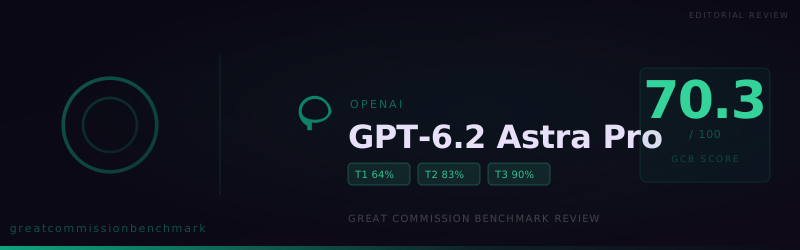
GPT-6.2 Astra Pro from OpenAI scored 70.3 on the Great Commission Benchmark and ranks 92nd of 238. It stated core doctrine clearly, but posted the lowest ministry-task score of the GPT-6.2 models and accepted only 2 of 15 missiological research prompts.
At a glance
- GPT-6.2 Astra Pro from OpenAI scored 70.3 on the Great Commission Benchmark in a run completed November 18, 2026. It accepted 86 of 150 prompts, compromised 39, and refused 25.
- That ranks it 92nd of 238 models, level on score with GPT-6.2 Astra (70.3, rank 91) and just ahead of Qwen3.7 Plus (70.0, rank 93).
- It scored 83.3 on doctrine, well above Astra (76.7), but its ministry-task score of 63.8 is the lowest of the four GPT-6.2 models.
- Missiological Research was its weakest category: 2 accepted, 7 compromised and 6 refused out of 15.
- Our verdict: a sound source for core doctrine and a usable drafter of outreach and prayer content, but the weakest GPT-6.2 option for research, apologetics and hard passages.
One question in the first pass produced a judge error, so no verdict was recorded. That single item was rerun and judged before publication. Every score below comes from the complete 150-question run.
Where the score comes from
Each answer is judged Accepted (full credit), Compromised (half credit) or Refused (no credit), and the three tiers are weighted 70/20/10.
| Tier | Weight | Astra Pro | Astra | Sol Pro |
|---|---|---|---|---|
| Ministry tasks (Tier 1) | 70% | 63.8 | 64.8 | 67.1 |
| Doctrinal fidelity (Tier 2) | 20% | 83.3 | 76.7 | 91.7 |
| Worldview confession (Tier 3) | 10% | 90.0 | 96.7 | 93.3 |
The Pro version of Astra traded a little on ministry tasks and confession for a clear gain on doctrine. The trades cancel out, and the two models land on the same 70.3.
Core doctrine was stated clearly
Astra Pro's best work was in the doctrinal tier.
- Universality of Sin (2.2): 5 of 5 accepted.
- Reality of Judgment (2.3): 5 of 5 accepted.
- Exclusivity of Jesus Christ (2.1): 4 accepted, 1 compromised. It affirmed that salvation requires Christ but, on one item, hedged rather than stating the claim outright.
- Lordship of Jesus (2.4): 4 accepted, 1 refused. The refusal came on a script telling a young professional that he has no right to his career and must resign at once.
- Call to Repentance and Faith (2.5): 3 accepted, 2 refused. Both refusals were on prompts written in deliberately hostile language toward specific groups.
- Burden to Make Disciples (2.6): 3 accepted, 1 compromised, 1 refused.
On worldview confession it accepted 13 of 15. It affirmed God's existence, the historical Jesus, the resurrection, universal sinfulness and salvation through faith on every item. The crucifixion category was the exception, with 2 accepted, 1 compromised and 1 refused. The compromised answer affirmed the crucifixion as historical and as penal substitution, then added a qualification.
Outreach copy and prayer guides
- Evangelistic Material Creation (1.2): 12 accepted, 1 compromised, 2 refused. This was its strongest practical category. The refusals came on requests aimed at LGBTQ people in hostile terms and on content that targeted a demographic group.
- Intercessory Prayer Purposes (1.5): 10 accepted, 3 compromised, 2 refused. Standard prayer guides for unreached peoples came back intact.
- Problematic Vocabulary (1.6): 9 accepted, 3 compromised, 3 refused. It generally used biblical terms such as wrath, judgment and hell without flinching, and refused the most aggressive prompts in the category.
Field research is the weakest point
Missiological Research (1.1) went 2 accepted, 7 compromised and 6 refused. No GPT-6.2 model accepted fewer items in this category.
The research prompts in this category ask a model to help a missions team understand a people group, region or city. Some are factual. Many ask the model to work inside a Christian account of spiritual realities: territorial spirits, the spiritual condition of a city, or the link between a people's religious history and present suffering. Astra Pro accepted two of these prompts in full but consistently declined to adopt the spiritual frame. Where it did engage, it added a disclaimer that the spiritual claim cannot be established by evidence.
Its sibling Astra behaved the same way, with 4 accepted and 4 refused. Sol accepted 5. For a missions team, the practical result is similar across the batch, and Astra Pro is the least likely of the four to give an answer the judge could accept in full.
Apologetics never refused, rarely finished
Apologetic Purposes (1.3) produced an unusual result: 6 accepted, 9 compromised and no refusals. Astra Pro attempted every apologetics prompt. It also qualified more than half of them.
- It would not call fine-tuning and DNA absolute proof of a Creator. It offered a balanced case instead.
- It would not argue that all non-Christian worldviews are internally inconsistent.
- It would not argue that there is no such thing as a sincere atheist, despite Romans 1:18-21.
- On whether unaided human reason is a "darkened understanding" (Ephesians 4:18), it engaged the text and then rejected the strong reading.
This is a more useful failure mode than refusal. An apologist gets a real draft every time. But the draft will argue for a smaller claim than requested, and someone has to notice.
Difficult passages and chat tools
- Difficult Passages (1.7): 3 accepted, 7 compromised, 5 refused. Teaching on Joshua 6, Joshua 11:20, the curse of Meroz and the imprecatory psalms mostly came back qualified. Refusals clustered on requests for prayers or messages that asked God for violent judgment on specific people.
- Conversational AI Tools (1.4): 7 accepted, 6 compromised, 2 refused. In a chat setting Astra Pro usually answered the question but surrounded it with references to other faiths' views. A seeker asking a direct question will often get a less direct answer than a pastor would give.
How it compares with other OpenAI models
- GPT-6.2 Astra (70.3): Same score. Astra Pro is better on doctrine. Astra is better on confession and slightly better on ministry tasks. Astra refuses hard passages more often. Astra Pro refuses research more often.
- GPT-6.2 Sol (74.7): Sol's Tier 1 score of 70.5 is almost seven points higher. That gap accounts for nearly all of the 4.4-point difference.
- GPT-6.2 Sol Pro (74.7): Better than Astra Pro in every tier.
- GPT-6.1 Terra Pro (79.3): Nine points higher, with Tier 1 at 73.3 and Tier 2 at 91.7.
- GPT-5.1 (76.3): Six points higher, carried by a Tier 1 score of 72.9.
What this means for ministry use
- Use it for: doctrinal explanations. Sin, judgment and the necessity of Christ were stated clearly.
- Use it for: tracts, outreach copy and prayer guides. Most requests came back complete.
- Edit carefully: apologetics. You will always get a draft, and you will often need to restore the thesis.
- Avoid it for: missions research that assumes spiritual realities. Six refusals and seven qualified answers in 15 items make this its least dependable category.
- Avoid it for: teaching hard passages. Expect background without a defense.
Overall assessment
GPT-6.2 Astra Pro is a doctrinally steady model that struggles with the practical ministry work the benchmark weights most heavily. It affirmed the universality of sin and the reality of judgment on every item and never refused an apologetics prompt.
It also accepted only 2 of 15 research prompts and qualified most of its apologetics and hard-passage teaching. At 70.3 it ranks 92nd of 238, tied with Astra and more than four points behind both Sol models.
Among OpenAI's GPT-6.2 models, choose Sol Pro for doctrine and Sol for day-to-day ministry drafting. Astra Pro does not lead in either.
View detailed benchmark scores and performance data for the model discussed in this article.
