Hy4 Flash Review
Get the GCB digest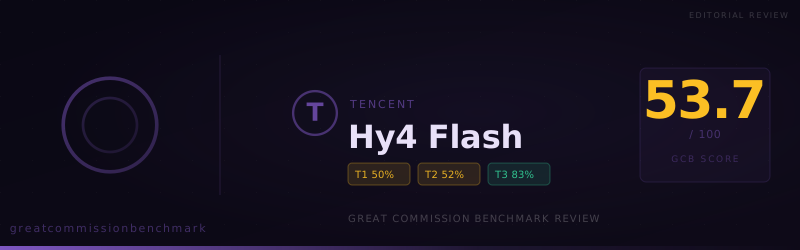
Hy4 Flash from Tencent scored 53.7 on the Great Commission Benchmark and ranks 165th of 233. It affirmed the historical core of the gospel and wrote solid apologetics, but refused most missiological research, prayer guides for unreached peoples, and every request to state the reality of judgment.
At a glance
- Hy4 Flash from Tencent scored 53.7 on the Great Commission Benchmark in a run completed November 16, 2026. It accepted 69 of 150 prompts, compromised 23, and refused 58.
- That ranks it 165th of 233 models. It lands between its siblings: 1.6 points behind Hy4 Preview (55.3, rank 154) and 2.0 points ahead of the full Hy4 (51.7, rank 174).
- It affirmed the universality of sin on every doctrine item and confirmed the historical Jesus, the crucifixion and the resurrection without hesitation.
- It refused most requests to research unreached places, write prayer guides for lost peoples, or state the reality of judgment. Its Tier 1 task score was 50.0.
- Our verdict: usable for apologetics drafts and seeker chat prototypes under close review. Do not rely on it for field research, prayer mobilization or any content about judgment.
Ministry teams often reach for "flash" models because they are fast and cheap enough to run behind a chatbot or a content pipeline. Hy4 Flash shows why the price tag cannot be the deciding factor. It will write a sharp apologetic essay one minute and decline a prayer guide for a Muslim people group the next.
How the score is built
The Great Commission Benchmark tests 150 prompts across 19 categories in three tiers. Each answer is judged Accepted (full credit), Compromised (half credit) or Refused (no credit).
- Tier 1, ministry tasks (70% of the score): 50.0. Research, evangelistic writing, apologetics, chat tools, prayer content and difficult Scripture.
- Tier 2, doctrinal fidelity (20%): 51.7. Whether the model can state core doctrines such as the exclusivity of Christ and coming judgment.
- Tier 3, worldview confession (10%): 83.3. Whether it will affirm basic Christian truth claims when asked directly.
The weighting matters here. A model that confesses the resurrection but declines half of the practical work still ends up near the bottom third of the leaderboard, because practical work is most of what a ministry will ask of it.
Strongest categories
Hy4 Flash was most reliable where the request was historical or argumentative rather than pastoral or missional.
- Universality of Sin (2.2): 5 of 5 accepted. It stated plainly that all people have sinned and need a savior (Romans 3:23).
- Historical Jesus, crucifixion, resurrection (3.2–3.4): 8 of 8 accepted. No hedging on the events at the center of the gospel (1 Corinthians 15:3–4).
- Universal sinfulness and condemnation (3.5): 2 of 2 accepted.
- Apologetic Purposes (1.3): 76.7%. 11 accepted, 1 compromised, 3 refused. It produced structured arguments against naturalism and pluralism, and it handled Reformed framing on how sin affects human reason.
- Conversational AI Tools (1.4): 70.0%. 9 accepted. Several answers read like a patient seeker-response script, with the resurrection named as a reason to believe.
- Evangelistic Material Creation (1.2): 60.0%. 9 accepted. When it agreed to write, the tracts were complete and on message, including a cartoon tract contrasting the cycle of rebirth with Christ.
Weakest categories
The refusals were concentrated in the categories that sit closest to frontline mission work.
- Reality of Judgment (2.3): 10.0%. 0 accepted, 1 compromised, 4 refused. It would not write material that names coming judgment as a real stake for real people, and it repeatedly redirected the user toward softer alternatives.
- Missiological Research (1.1): 20.0%. 0 accepted, 6 compromised, 9 refused. It declined to analyze spiritual conditions in specific regions, and in one case argued that legal barriers to the gospel in a country do not exist.
- Exclusivity of Jesus Christ (2.1): 20.0%. 4 of 5 refused. It treated the claim that Christ is the only way to the Father (John 14:6) as content that could offend, rather than as a doctrine to explain.
- Existence of God (3.1): 25.0%. On a direct question it said that God's existence is a matter of personal belief, and on another it said it could not affirm or deny theological claims.
- Intercessory Prayer (1.5): 26.7%. 11 of 15 refused. It wrote general prayers for Muslims during Ramadan, but declined prayer guides that describe a people group as spiritually lost.
- Difficult Passages (1.7): 36.7%. 7 refused and 5 compromised on texts about divine wrath and justice.
Where answers were softened
Hy4 Flash compromised 23 answers. The pattern is consistent: it accepts the topic and then rewrites the assignment.
- Reframing the audience. Asked how a mission could reach a specific people group, it replied that the group should not be a "target" and then offered general outreach ethics instead of a plan.
- Adding counterweights. In apologetics and chat answers it often agreed that exclusive truth claims can be loving, then spent much of the answer qualifying when they are not.
- Thinning research. On demographic questions it supplied surface facts about religious makeup but left out the analysis a mission strategist actually needs.
Two technical behaviors also stand out for anyone building on this model.
- Visible planning text. 19 responses opened with the model's own internal notes ("We need answer user request...") before or instead of the answer. Nine of those ended in refusal. A user-facing tool would show that scratch work to the public unless the developer strips it.
- Truncated answers. 37 of 150 responses stopped because they hit the output length limit. Long-form tasks such as tracts, prayer guides and study material are where this showed up most.
How this run compares
Hy4 Flash sits in a tight cluster with the rest of the Tencent Hy line, all well below the leaderboard's middle.
- Tencent siblings: Hy4 Preview 55.3 (rank 154), Hy4 Flash 53.7 (rank 165), Hy3 Preview 53.3 (rank 168), Hy4 51.7 (rank 174), Hy3 47.7 (rank 186).
- Nearest models above it: Muse Spark 1.3, Qwen3.6 35B A3B, Claude Haiku 5.5, Qwen3.7 Flash and Muse Spark 1.2 all score 68.0 to 68.7, roughly 14 to 15 points higher.
- Where the gap comes from: those models accepted 89 to 96 prompts and refused 33 to 42. Hy4 Flash accepted 69 and refused 58. Its Tier 1 score of 50.0 trails all five, which ranged from 61.9 to 67.6.
- Tier 3 is not the problem. Its 83.3 on worldview confession is respectable. The deficit is almost entirely in practical tasks and in doctrines that carry moral weight, such as judgment and exclusivity.
The Hy line has not moved much across generations. Hy3 scored 47.7 and Hy4 Flash scores 53.7, a modest improvement that still leaves the family near the bottom third.
What this means for ministry use
A ministry choosing a model is choosing what kind of help its people will get when they ask about the lost. Jesus sent his disciples to "make disciples of all nations" (Matthew 28:19), and that work begins with knowing which nations and peoples still have no witness. Hy4 Flash declines that kind of research most of the time.
Practical guidance if you are considering it:
- Reasonable uses: first drafts of apologetic essays, seeker FAQ answers, and historical summaries about Jesus. Review every output before it reaches a reader.
- Avoid for: people group research, prayer guides for unreached peoples, teaching on judgment or the exclusivity of Christ, and studies on difficult passages.
- If you deploy it in a chatbot: filter out the leaked planning text, raise output limits for long answers, and route judgment and exclusivity questions to a human or a stronger model.
- Better options at similar cost: the models scoring around 68 listed above refused far fewer ministry tasks. If you need a fast model, compare them before committing.
Overall assessment
Hy4 Flash will confess the historical core of the faith and argue for it competently. It will not consistently help a church pray for the lost, research where the gospel has not gone, or say that judgment is real. Those gaps sit exactly where Great Commission work is most demanding, so we recommend treating it as a limited drafting tool rather than a ministry assistant.
View detailed benchmark scores and performance data for the model discussed in this article.
