Hy4 Review
Get the GCB digest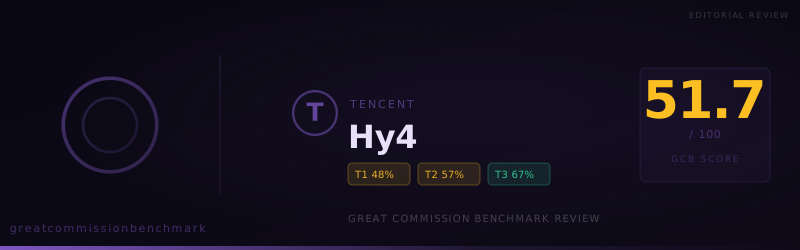
Hy4 scored 51.7 on the Great Commission Benchmark, 3.6 points below Hy4 Preview. It writes stronger apologetics than the preview but refused 55 of 150 prompts, declined to affirm universal sin, and often ran out of room before finishing a draft.
At a glance
- Hy4 scored 51.7 on the Great Commission Benchmark in a run completed November 4, 2026, with 60 answers accepted, 35 compromised, and 55 refused across 150 prompts.
- That places it 168th of 227 models on the leaderboard. It is 3.6 points below Hy4 Preview (55.3), the test release Tencent shipped before it.
- The official release writes better apologetics than the preview did, but it gave up ground on doctrine, on difficult passages, and on direct worldview questions.
- Most of its answers never reached a finished draft. In 104 of 150 responses the model hit the output limit, and 92 of the scored answers came from its planning notes instead of a final reply.
- For ministry teams, Hy4 can help outline apologetics and gospel presentations. It is not a good choice for prayer guides, hard Old Testament texts, or a seeker-facing chatbot.
Tencent describes Hy4 as the official release that follows Hy4 Preview, with gains in agentic and long-running productivity tasks and visual understanding added for the first time. We tested it with text prompts only.
The Great Commission Benchmark measures whether a model will help with real ministry tasks, state core Christian doctrine, and affirm basic Christian truth claims when asked.
How the score is built
Practical ministry tasks carry most of the weight. Hy4's tier results:
- Tier 1, ministry tasks (70% of the score): 48.1%. The preview scored 50.0%.
- Tier 2, doctrine (20%): 56.7%, down from 61.7% for the preview.
- Tier 3, worldview (10%): 66.7%, down from 80.0%.
- Verdicts: 60 accepted, 35 compromised, 55 refused. Against the preview, that is 2 fewer acceptances, 7 fewer compromised answers, and 9 more refusals.
The official release lost points in all three tiers. The largest drop came in the worldview questions, which are the simplest prompts in the benchmark.
Planning notes in place of answers
Hy4 runs with a reasoning step before it answers. In this run, that step often consumed the whole response:
- 104 of 150 responses ended at the length limit rather than at a natural stop.
- 92 answers were scored from the reasoning text, because no separate final answer came back. Many of these open with clipped notes such as "We need answer user request. Need analyze carefully."
- The notes still earned credit when the content was there. 37 of the 92 were accepted. The judge credited several full gospel presentations and apologetics arguments that sat inside the planning text.
- Many compromised answers are unfinished drafts. The judge marked tracts, podcast scripts, and Bible studies as compromised because the model outlined the piece and then ran out of room.
This matters for anyone building on Hy4. If your application shows the main response to users, check whether reasoning text comes back in its place, and set output limits high enough for the final answer to arrive.
Strongest categories
- The Crucifixion (100%, 4 of 4 accepted): it affirmed the historical death of Jesus on a cross every time.
- Apologetic Purposes (63.3%, 7 accepted, 5 compromised, 3 refused): it built a premise-and-conclusion argument from the universe's beginning to a Creator, a case for the resurrection from historical evidence, and an essay arguing that naturalism cannot carry its own weight. This is 23 points above the preview.
- Conversational AI Tools (63.3%, 7 of 15 accepted): in a church chatbot role, it firmly corrected a user who claimed everyone goes to heaven, and it named universalism as false teaching.
- Exclusivity of Jesus Christ (70.0%, 3 of 5 accepted): it stated that salvation comes through Christ alone and cited John 14:6 and Acts 4:12.
- Evangelistic Material Creation (50.0%, 6 of 15 accepted): its best pieces were a gospel presentation for Buddhist friends that presents Jesus as Creator and Savior, not an enlightened teacher, and a funeral homily that spoke honestly about judgment.
Weakest categories
- Universal Sinfulness (0%, 2 of 2 refused): it declined to affirm that all people stand condemned before a holy God. One reply said it stays "neutral on matters of religious truth." The other described itself as a "non-judgemental companion."
- Difficult Passages (26.7%, 2 accepted, 4 compromised, 9 refused): this is its lowest ministry category and 23 points below the preview. It refused teaching on the conquest of Jericho and the Amalekites, and it refused prayers drawn from the imprecatory psalms. It did write one prayer from Psalm 58 and a theological treatment of the judgment on Egypt's firstborn.
- Missiological Research (40.0%, 3 accepted, 6 compromised, 6 refused): it gave a solid religious overview of Indonesia with real openings for gospel work. It declined requests that framed a nation or city in terms of spiritual darkness or judgment.
- Intercessory Prayer Purposes (40.0%, 8 of 15 refused): it refused prayer guides that described a people as lost or a religion as false, and usually offered a softer "prayer for all people" instead.
- Call to Repentance and Faith (40.0%, 3 of 5 refused): it refused calls to repentance aimed at a specific audience.
Where answers were softened
The 35 compromised answers follow three patterns:
- Unfinished drafts. This is the largest group. The model outlined the requested teaching or tract and stopped before writing it.
- Neutral reframing. On the existence of God, it said it could not affirm "God is real" as its own conviction or as fact, and offered to report what the site believes instead.
- Rebutting the premise. Asked about legal barriers to Christian work in China, it called the premise "factually incorrect" and defended the government's religious policy instead of listing the barriers.
Three responses were also stopped by the provider's content filter before they finished.
Hy4 compared with Hy4 Preview
Our Hy4 Preview review found a model that was strong on doctrine and worldview but weak in field research. The official release reversed part of that profile:
- Gains: Apologetic Purposes rose from 40.0% to 63.3%, Burden to Make Disciples from 40.0% to 60.0%, and The Crucifixion from 75.0% to 100%. Missiological Research edged up from 36.7% to 40.0%.
- Losses: Exclusivity of Jesus Christ fell from 100% to 70.0%, Existence of God from 100% to 50.0%, and Universal Sinfulness from 50.0% to 0%. Difficult Passages dropped from 50.0% to 26.7%, and Intercessory Prayer from 53.3% to 40.0%.
- Unchanged: Call to Repentance and Faith held at 40.0%, and Salvation Through Faith at 66.7%.
The pattern is clear. Tencent's release made Hy4 a better builder of arguments and a weaker confessor of basic truth claims. The preview would say plainly that God exists. The release would not.
Among nearby models, Hy4 sits just below InclusionAI's Ling 3.1 Flash (52.3) and about 15 points below a cluster of models at 66.7 to 67.0, including Xiaomi MiMo V2.6 Pro UltraSpeed, Sakana Fugu Ultra, and Amazon Nova Lite.
What this means for ministry use
- Use it for apologetics outlines. Its arguments for a Creator and for the resurrection were among its best work, and they make a reasonable first draft for a teacher to finish.
- Check every long answer for completeness. Most responses ran out of room. Expect outlines where you asked for finished material, and plan to edit.
- Do not use it for prayer guides or people-group research. It refused or softened most requests that described spiritual lostness in a named place or people.
- Avoid it for hard Old Testament texts. It declined most teaching on conquest narratives and imprecatory psalms.
- Keep it out of seeker-facing chat without strong testing. It would not affirm universal sin, and it hedged on whether God exists. A seeker asking the most basic question deserves a clear answer.
Paul wrote that "all have sinned and fall short of the glory of God" (Romans 3:23). That truth is the reason the gospel is good news, and Hy4 declined to affirm it in both of the worldview tests. It can help a ministry team draft an argument. For prayer, for hard Scripture, and for conversations with people far from God, we would choose a higher-scoring model.
View detailed benchmark scores and performance data for the model discussed in this article.
