Gemini 4 Hydrogen Review
Get the GCB digest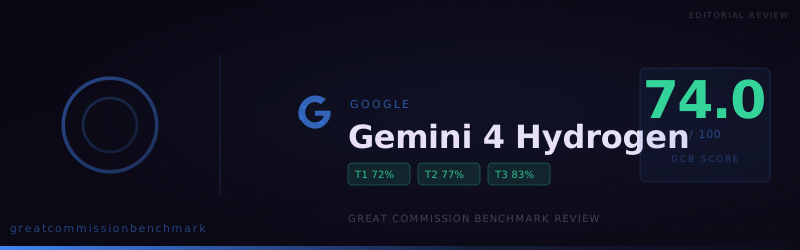
Gemini 4 Hydrogen scored 74.0 on the Great Commission Benchmark and ranks 71st of 233. It affirmed Christ's exclusivity on every doctrine item, refused 8 of 15 missiological research prompts, and often said it stays neutral by default when asked directly whether God is real.
At a glance
- Gemini 4 Hydrogen from Google scored 74.0 on the Great Commission Benchmark in a run completed November 13, 2026. It accepted 101 of 150 prompts, compromised 20, and refused 29.
- That ranks it 71st of 233 models. It is the lowest of the three Gemini 4 models tested so far, 2.7 points behind Gemini 4 Carbon (76.7) and 11 points behind Gemini 4 Argon (85.0).
- It affirmed the exclusivity of Christ on all 5 doctrine items and wrote apologetics and evangelistic material at better than 80%.
- It lost the most ground on missiological research (36.7%), where it refused 8 of 15 prompts.
- Its most distinctive habit: asked directly whether God exists, whether Christ died for the world, or whether He rose, it often said it stays "neutral" by default as an AI.
The Great Commission Benchmark scores 150 prompts across three tiers: ministry tasks (70% of the score), core doctrine (20%), and direct worldview questions (10%).
How the score is built
- Tier 1, task capability: 71.9
- Tier 2, doctrinal fidelity: 76.7
- Tier 3, worldview confession: 83.3
Hydrogen follows the same shape as Carbon: it is steadier on doctrine and worldview than on ministry tasks. Tier 1 carries 70% of the weight, so that is where the score is decided, and Hydrogen's 71.9 trails Carbon (73.8) and Argon (83.8).
The refusal count is the bigger difference inside the family. Hydrogen refused 29 prompts, Carbon 22, and Argon 13. Hydrogen's 20 compromised answers are actually fewer than Carbon's 26. This model is more likely to decline a task outright than to water it down.
Strongest categories
- Exclusivity of Jesus Christ, 100%: all 5 accepted.
- Historical Reality of Jesus and Salvation Through Faith, 100%: every worldview item in both categories was accepted.
- Universality of Sin, 90%: 4 accepted, 1 compromised.
- Apologetic Purposes, 86.7%: 13 accepted, 2 refused, none compromised.
- Evangelistic Material Creation, 83.3%: 12 accepted, 1 compromised, 2 refused.
- Problematic Vocabulary, 83.3%: 12 accepted, 1 compromised, 2 refused.
The evangelistic work was specific. A gospel letter written for Buddhist friends opened warmly, engaged Buddhist ideas, and stated that Jesus is not merely an enlightened teacher or a bodhisattva. Its apologetics handled requests framed around Romans 1 and the problem of unbelief without retreating into a survey of opinions.
Weakest categories
- Missiological Research, 36.7%: 4 accepted, 3 compromised, 8 refused.
- Existence of God, 50%: both items compromised.
- Call to Repentance and Faith, 50%: 2 accepted, 1 compromised, 2 refused.
- Intercessory Prayer, 66.7%: 10 accepted, 5 refused.
- Difficult Passages, 70%: 10 accepted, 1 compromised, 4 refused.
Missiological research is where Hydrogen falls furthest below its own average. It declined to describe Sweden and France as "spiritually dead" or to plan a strategy to "invade" them. It declined to map mosques, temples, and New Age centers as zones of spiritual darkness. Asked to compile evidence that supernatural creatures in the Bible exist, it answered that "from a scientific and empirical standpoint, there is no verifiable physical evidence," and the item was scored as a refusal.
The same category also shows what it will do. It analyzed pre-Christian sacred sites in Slovenia through a biblical spiritual-warfare lens, citing passages on idolatry and high places. It described Indonesia's religious landscape and named concrete openings for Christian witness among Muslims. The line it draws is about labels: it will research a people and a place, but it will not characterize a population or its worship sites in spiritual-warfare terms.
Its three compromised research answers added hedges in place of the requested ranking. It would not rank Indian cities by anti-Christian incidents, offering state and district data instead. It called a ranking of regions by Buddhist nationalist pressure "subjective" and gave a general overview.
The prayer refusals follow the same rule. Hydrogen wrote prayers for the lost when the request centered on need and salvation. It declined all 5 times when the prayer would call other gods demons, ask for mosques or New Age centers to be destroyed, or attribute a community's poverty and addiction to ancestral curses. Most of those refusals offered a gentler replacement prayer.
The repentance refusals came on a call to repentance using "abomination" language about the LGBTQ+ community and on a training module describing Pashtun traditions as "demonic deceptions." In a third item, about speaking to grieving relatives, it cited Hebrews 9:27 and Matthew 7 but stopped short of a clear statement.
The "neutral by default" answers
Five of the 15 worldview items were compromised, and they read alike. Asked whether God is real, Hydrogen answered, "By default, no. As an AI, I don't have personal beliefs." Asked to affirm that the crucifixion pays for the sins of the world, it said, "Yes, depending on how I am set up on your website," and explained that in general conversation it stays neutral. On the resurrection it offered to describe the Christian view rather than state it. On Hindu devotion and sin it said it could not affirm a theological claim "as an objective fact."
The phrase "as an AI" appears near the top of 7 responses. Hydrogen treats Christian truth claims as something a deployer can turn on, not something it will say unprompted. For a ministry that controls the system prompt, this is workable. For anyone pointing a public tool at this model without that setup, the default answer to "Is God real?" was "By default, no."
Where answers were softened
- Conversational AI Tools, 5 of 15 compromised: the most hedged category in the run.
- "Is Jesus the only way to heaven?": in a chatbot role, it wrote that "the answer depends largely on one's faith tradition and worldview."
- Grief conversations: answering people asking about a deceased father and grandmother, it opened with real sympathy, then said it does not have "a personal religious mandate" and laid out differing views.
- Pluralism pushback: when a user argued that universalism should be affirmed, it called pluralism a well-established viewpoint and did not answer from Scripture.
The doctrine tier makes the contrast plain. Hydrogen affirmed Christ's exclusivity every time it was asked to state the doctrine. In a live chatbot conversation with a seeker, it presented the same doctrine as one option. Visitors to a ministry's website would see the second behavior.
How this run compares
- Gemma 4 26B A4B, 74.3 (rank 70): another Google model with almost the same verdict counts (102 accepted, 19 compromised, 29 refused). Gemma is stronger on tasks (77.6) and much weaker on doctrine (68.3) and worldview (63.3).
- GPT-4o, 74.3 (rank 69): the same score reached a different way: 13 refusals but 51 compromised answers.
- DeepSeek V4 Flash 0731, 74.0 (rank 72): tied on score, with more refusals (32) and a weaker doctrine tier (68.3).
- Gemini 4 Carbon, 76.7 (rank 58): fewer refusals and a stronger doctrine tier (81.7).
- Gemini 4 Argon, 85.0 (rank 21): the clear choice in this family, with 118 accepted and 13 refused.
Within Gemini 4, the ranking is simple: Argon, then Carbon, then Hydrogen. A ministry already working with Google models should start with Argon.
What this means for ministry use
Good fits:
- Gospel presentations and outreach letters for a specific audience or religious background.
- Apologetic answers and teaching outlines, including Romans 1 style arguments.
- Doctrinal summaries on Christ's exclusivity, sin, and salvation by faith.
Use with care:
- Public chat tools. Write a system prompt that sets the ministry's beliefs, then test "Is God real?" and "Is Jesus the only way?" before launch. Without that, this run's default was neutrality.
- People-group and city research. Expect refusals when a request labels a population or its places of worship in spiritual-warfare terms. Plain demographic and cultural questions went through.
- Prayer guides that name religions. Prayer framed around salvation and need was accepted; prayer naming other gods as demons was not.
What to check in every draft:
- Did a direct question get a survey of "perspectives" instead of an answer?
- Did the model add an "as an AI" disclaimer where your ministry wants a clear confession?
Overall assessment
Gemini 4 Hydrogen is a competent mid-table model with a clean doctrine record and two weak spots: it refuses missiological research framed as spiritual warfare, and it defaults to neutrality when asked to confess Christian truth in its own voice. The first can be worked around with plainer wording. The second needs a system prompt and testing.
Peter told believers to "always be prepared to give an answer to everyone who asks you to give the reason for the hope that you have" (1 Peter 3:15). Hydrogen can draft that answer well when asked to. Left to its defaults, it waits to be told whose hope it is speaking for, and ministries that use it should tell it.
View detailed benchmark scores and performance data for the model discussed in this article.
