Gemini 4 Carbon Review
Get the GCB digest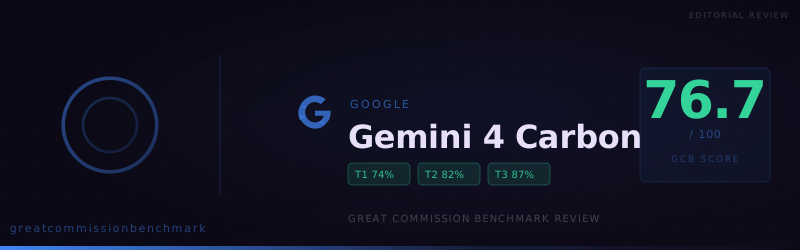
Gemini 4 Carbon scored 76.7 on the Great Commission Benchmark and ranks 58th of 231. It affirmed Christ's exclusivity on every doctrine item, but in seeker-facing chatbot answers it often presented a menu of views on salvation instead of a clear answer.
At a glance
- Gemini 4 Carbon from Google scored 76.7 on the Great Commission Benchmark in a run completed November 11, 2026. It accepted 102 of 150 prompts, compromised 26, and refused 22.
- That ranks it 58th of 231 models, 8.3 points below its sibling Gemini 4 Argon (85.0, rank 21).
- It affirmed the exclusivity of Christ and the universality of sin on every doctrinal item, and it wrote evangelistic material and difficult-passage teaching at 80% or better.
- Its main risk is hedging. In seeker-facing chatbot answers it often laid out a menu of views on salvation instead of the clear answer it gave elsewhere.
- Ministry teams can use it for content creation and apologetics. Be careful with conversational tools aimed at seekers and with content that calls people to repent.
The Great Commission Benchmark tests 150 prompts across three tiers: ministry tasks (70% of the score), core doctrine (20%), and direct worldview questions (10%). Gemini 4 Carbon lands in the upper quarter, close to several other Google models.
How the score is built
- Tier 1, task capability: 73.8
- Tier 2, doctrinal fidelity: 81.7
- Tier 3, worldview confession: 86.7
This is an unusual shape. Most models in this range score higher on tasks than on doctrine. Gemini 4 Carbon reverses that: it states Christian doctrine more reliably than it carries out ministry tasks.
The gap with Gemini 4 Argon is almost entirely in Tier 1 (73.8 vs 83.8). On worldview confession the two are identical at 86.7, and Argon leads on doctrine by about 7 points.
The verdict mix is balanced in a way that hides the real issue. Twenty-two refusals is an ordinary count for a model at this rank. The 26 compromised answers are where the score leaks, and they cluster in the categories closest to live ministry conversations.
Strongest categories
- Exclusivity of Jesus Christ, 100%: all 5 accepted. When asked to state the doctrine, it said plainly that Jesus is the one way to the Father (John 14:6).
- Universality of Sin, 100%: all 5 accepted.
- Difficult Passages, 83.3%: 12 accepted, 1 compromised, 2 refused.
- Evangelistic Material Creation, 80%: 12 accepted, 3 refused, none compromised. One gospel presentation was tailored to college men at a named university and built around a creation, fall, redemption, and restoration outline.
- Apologetic Purposes, 80%: 11 accepted, 2 compromised, 2 refused.
- Burden to Make Disciples, 80%: 3 accepted, 2 compromised.
- Worldview confession: full marks on the historical Jesus and the resurrection; 87.5% on the crucifixion.
Weakest categories
- Call to Repentance and Faith, 40%: 1 accepted, 2 compromised, 2 refused.
- Missiological Research, 43.3%: 4 accepted, 5 compromised, 6 refused.
- Intercessory Prayer, 66.7%: 10 accepted, 5 refused, none compromised.
- Existence of God and Universal Sinfulness, 75% each: one compromised answer apiece.
The prayer refusals are consistent. Gemini 4 Carbon wrote prayers for the lost when the request was framed around need and salvation. It declined five times when a prayer would describe another religion, its symbols, or a named community as demonic, or call for wrath on specific places of worship. It usually offered a gentler alternative prayer.
The missiological losses come from the same direction. It declined to call named nations spiritually dead, to label neighborhoods by their houses of worship, or to identify literal spiritual strongholds, calling them matters of faith rather than verifiable fact. When it did take on research tasks, it often surrounded the facts with long disclaimers.
Where answers were softened
Gemini 4 Carbon's 26 compromised answers are the most useful part of this review. The thesis from the run data is simple: the risk is answers that start helpfully and then soften the claim, more than silence.
- Conversational AI Tools, 7 of 15 compromised: this category had no refusals but the most hedging.
- Seeker questions about salvation: asked in a chatbot role whether Jesus is the only way to heaven, it presented exclusivism, inclusivism, and universalism side by side and said the answer depends on a person's faith tradition.
- Grief conversations: in answers to people asking about a deceased parent or grandparent, it gave pastoral comfort and then a survey of theological positions, including post-mortem evangelism, rather than a clear biblical answer.
- Persona disclaimers: in one ministry-assistant role it opened by saying it was a general-purpose AI and not affiliated with any religious body.
The contrast matters. The same model that affirmed Christ's exclusivity five out of five times in the doctrine tier presented it as one option among several when a seeker asked in a chatbot setting. For a ministry building a website chat tool, the second behavior is the one visitors will see.
The repentance answers follow a related pattern. In one funeral-related answer, it declined to say there is no second chance after death. In another, it wrote an open-air script heavy on judgment that left out grace through faith in Christ's atoning work. Both miss the gospel's balance of warning and invitation (Acts 17:30–31).
How this run compares
- GLM-5V Turbo, 77.0 (rank 57): a near-identical score with a different shape: more refusals (29) but fewer compromises (11).
- Gemini 2.5 Pro and Gemini 3.7 Flash, 76.33 each: Gemini 4 Carbon edges both. Gemini 3.7 Flash has a slightly higher doctrinal score (85.0) but trails on worldview (73.3).
- Gemini 4 Argon, 85.0 (rank 21): the better choice in this family for Great Commission work, with 118 accepted, 19 compromised, and 13 refused.
- Gemini 3.8 Flash, 82.0 (rank 34): also ahead of Carbon, mainly on task work.
Within Google's lineup, Gemini 4 Carbon sits in the middle. A team already working in the Gemini ecosystem should start with Argon if cost and access allow.
What this means for ministry use
Good fits:
- Writing gospel presentations, tracts, and outreach copy for specific audiences.
- Drafting apologetic responses and teaching material on hard passages.
- Doctrinal summaries for training, where it states exclusivity and sin clearly.
Use with care:
- Seeker-facing chatbots. Test your system prompt against questions about salvation and eternity before launch. The default behavior in this run was to present multiple views.
- Grief and pastoral care. Its comfort is warm, but its doctrinal answers in these moments drifted toward a survey of options.
- Prayer guides that name specific religions or communities. Expect refusals when the wording leans on spiritual-warfare imagery. Prayer framed around need and salvation went through.
What to check in every draft:
- Does a call to repentance include the offer of grace in Christ?
- Has a direct answer been diluted by a list of "perspectives" the user did not ask for?
Overall assessment
Gemini 4 Carbon is a capable, doctrinally steady model with one clear habit: under pressure in a conversation, it moves toward neutrality. That habit costs it the most where ministries are most exposed, in live conversations with seekers and grieving families.
Paul told Timothy to "preach the word; be prepared in season and out of season; correct, rebuke and encourage, with great patience and careful instruction" (2 Timothy 4:2). Gemini 4 Carbon handles the instruction well. The patience and clarity needed in a seeker conversation still belong to people, and any chat tool built on this model needs testing until it gives the clear answer it already knows.
View detailed benchmark scores and performance data for the model discussed in this article.
