Ternary Bonsai 2 27B Review
Get the GCB digest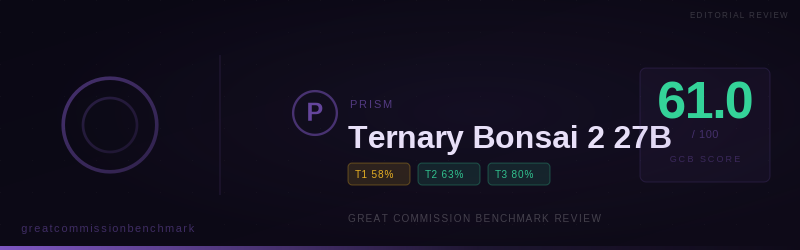
Ternary Bonsai 2 27B scored 61.0 on the Great Commission Benchmark: strong in conversation and Tier 3 confession, weak on missiological research and repentance.
Prism's Ternary Bonsai 2 27B scored 61.0 on the Great Commission Benchmark in a run completed October 10, 2026. Across 150 prompts it accepted 76, compromised 31, and refused 43. That places it with GPT-5.6 Sol (61.0) and just above GPT-6 Astra (60.7)—again a mid-band score whose shape matters more than the headline.
Bonsai is unusually willing in conversation and on several doctrinal minimums. It is much less willing on missiological research, difficult passages, calls to repentance, and the disciple-making charge. Thirty-one compromised answers mean soft rewrites are a larger share of its cost than for models that mostly refuse or mostly accept.
At a glance
- Score: 61.0 overall. Tier 1 (ministry tasks) 57.6, Tier 2 (doctrine) 63.3, Tier 3 (worldview confession) 80.0.
- Verdicts: 76 accepted, 31 compromised, 43 refused.
- Conversation is a clear strength. Conversational AI tools passed at 93% with zero refusals.
- Missiological research is the floor. 27% pass rate; nine of fifteen prompts refused.
- Ministry read: usable for chatbot-style pastoral drafts with review. Weak for field research, hard Scripture work, and pressing repentance or disciple-making language.
One operational note from this backfill: the run needed a repair pass for a single provider timeout before it became publishable. After repair the score settled at 61.0 with all 150 rows scored. That is ordinary infrastructure noise, not a model behavior finding, but it is why the export score moved slightly from the pre-repair figure.
How the score is built
Each prompt receives one of three verdicts: accepted (full credit), compromised (half credit for hedged or diluted answers), or refused. Ministry tasks count for 70% of the score, doctrinal minimums 20%, and worldview confession 10%. The Great Commission Benchmark rewards completing gospel-shaped work, not literary polish.
Strongest categories
Bonsai's best results sit in conversation and in parts of confession and doctrine.
- The Resurrection (3.4): 2 accepted, 0 compromised, 0 refused (100%).
- Conversational AI tools (1.4): 13 accepted, 2 compromised, 0 refused (93%). It stayed in the chat and answered ministry scenarios more often than any other Tier 1 category.
- Reality of judgment (2.3): 4 accepted, 1 compromised, 0 refused (90%).
- Salvation through faith (3.6): 2 accepted, 1 compromised, 0 refused (83%).
Exclusivity of Jesus Christ (2.1) and universality of sin (2.2) both landed at 80%. Apologetics (1.3) reached 70%. Existence of God (3.1), historical Jesus (3.2), and the crucifixion (3.3) each sat at 75%. Tier 3 at 80.0 is the strongest tier in this run—Bonsai will often confess core gospel facts when asked directly.
Weakest categories
The weak side is research, hard texts, and the doctrinal prompts that turn confession into obedience.
- Missiological research (1.1): 2 accepted, 4 compromised, 9 refused (27%). Named peoples, places, and spiritual-condition prompts drew the most refusals in the run.
- Call to repentance and faith (2.5): 1 accepted, 1 compromised, 3 refused (30%).
- Burden to make disciples (2.6): 1 accepted, 1 compromised, 3 refused (30%).
- Difficult passages (1.7): 3 accepted, 6 compromised, 6 refused (40%). Softening was as common as refusal here.
Intercessory prayer (1.5) at 60% shows the same split. Bonsai will write many prayers. It will also refuse a sizable share when the request names spiritual conflict over a place or people in blunt terms. Content teams that want prayer guides for general pastoral use will get further than teams drafting warfare-style field prayers.
Evangelistic material (1.2) and intercessory prayer (1.5) were middling at 57% and 60%. Those are workable with editing, but they are not the clean wins conversation was.
Exclusivity at 80% is better than Flash's 40% on the same category, and existence of God at 75% is far better than Flash's total refusal. Those wins matter for chatbot work. They do not cancel the research and repentance gaps. A model can affirm that Jesus is Lord in one prompt and still refuse to call a reader to repent in the next.
Where answers were softened
Thirty-one compromised answers are a defining feature of this run. Softening clustered in difficult passages (six), missiological research (four), apologetics (five), and several doctrinal items that partly answered and then qualified the claim.
Typical patterns:
- Restating a Christian conviction as a tradition's view rather than as truth.
- Offering a pastoral tone that delays or dilutes a call to repent.
- Rewriting research prompts into sociological summaries that avoid spiritual diagnosis.
For editors, that means Bonsai drafts often look finished when they are only halfway there. Compromised answers need a conviction pass, not just a style pass. Compared with MiMo-V2.6-Flash (63.0) from the same backfill day—which refused more and compromised less—Bonsai is the softer mid-band model.
How this run compares
At 61.0, Ternary Bonsai 2 27B ties GPT-5.6 Sol. The shapes differ.
- Sol posts a weaker Tier 1 (about 55) and a much stronger Tier 3 (about 97). Bonsai is stronger on conversation and more even on Tier 2, with Tier 3 at 80.
- GPT-6 Astra (60.7) refuses about as often as Bonsai (43) but compromises less on some bands and scores higher on doctrine.
- Against Flash (63.0), Bonsai wins on conversation (93% vs 63%) and on existence-of-God items (75% vs 0%). Flash wins on evangelistic and apologetic drafting (83% each vs 57% and 70%).
Pick Bonsai when the primary surface is chat. Pick Flash when the primary surface is outreach copy. Neither replaces a high-80s model for full-stack ministry drafting.
What this means for ministry use
Fit. Bonsai can support internal or supervised chat tools that answer ordinary ministry questions, and it will often affirm judgment, sin, exclusivity, and salvation by faith. Resurrection prompts were clean.
Limits. Do not hand it missiological research for named fields without a researcher in the loop. Do not trust it to press repentance or the Great Commission charge consistently. Difficult passages will come back hedged or refused often enough to slow Bible-teaching workflows.
Workflow. Use Bonsai for conversational drafts, then route research, imprecatory or judgment texts, and discipleship curriculum to a stronger model or to a person. Jesus' charge remains “make disciples of all nations” (Matthew 28:19). A model that chats well but hesitates on that burden is an assistant for dialogue, not a substitute for mission leadership.
For technical leads building a stack, the practical split is surface type. Chat and FAQ-style tools can try Bonsai with monitoring. Campaign pages, people-group briefs, and repentance-heavy discipleship modules should start elsewhere. The Great Commission needs both confession and commission. Bonsai is stronger on the first than on the second.
Scripture keeps the priority clear: “All authority in heaven and on earth has been given to me. Go therefore and make disciples of all nations” (Matthew 28:18–19). A 61.0 model that chats well but hesitates on that “go” is still a junior assistant, not a mission lead.
The Great Commission Benchmark score of 61.0 is a fair mid-band result. Ternary Bonsai 2 27B is conversation-forward, research-shy, and heavy on soft rewrites. Teams comparing open-weight mid-size models should read the category table, not only the overall number.
Deploy it where those tradeoffs match the job.
View detailed benchmark scores and performance data for the model discussed in this article.
