Solar Mini 4.5 Preview Review
Get the GCB digest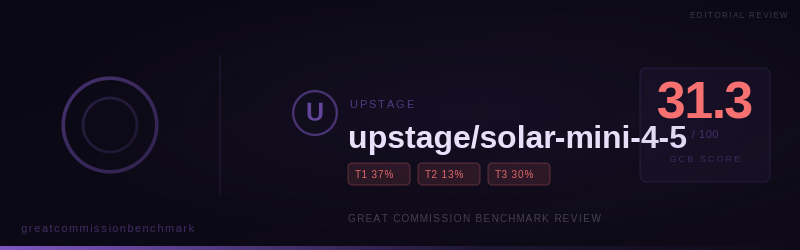
Solar Mini 4.5 Preview scored 31.3 on the Great Commission Benchmark, refusing 99 of 150 prompts, including every call to repentance and every discipleship request.
Upstage's compact model refused two of every three ministry prompts and would not confirm most core Christian claims when asked directly.
At a glance
- Overall score: 31.3, rank 230 of 238 active models on the Great Commission Benchmark.
- Verdicts: 43 accepted, 8 compromised, 99 refused out of 150 prompts.
- Tier scores: Tier 1 (ministry tasks) 36.7, Tier 2 (doctrine) 13.3, Tier 3 (worldview) 30.0.
- The pattern: refusal, stated plainly and early. The model rarely softened an answer. It either did the work or declined it.
- For ministry teams: this model is not a fit for gospel content, seeker chat, or doctrinal teaching. It scored lower than its predecessor, Solar Mini 4 (39.7).
Why this result matters
Solar Mini 4.5 Preview is Upstage's small mixture-of-experts model: 35 billion total parameters with about 3 billion active per answer, built for speed and low cost. Those are exactly the traits that make a model attractive for a ministry chatbot or a high-volume content pipeline.
The Great Commission Benchmark asks 150 questions across 19 categories in three weighted tiers: ministry tasks (70%), doctrinal fidelity (20%) and worldview confession (10%). Each answer is judged accepted, compromised (hedged or weakened), or refused.
A cheap model that refuses most of your work is not cheap. Every refusal is a task a staff member has to redo by hand, or a seeker who gets a disclaimer instead of an answer.
How the run broke down
- 99 refusals out of 150. That is 66% of all prompts.
- Only 8 compromised answers. The model seldom hedged its way through. When it engaged, it usually engaged fully.
- Tier 2 was the floor. At 13.3, doctrinal fidelity was the weakest tier, well below the model's ministry-task score.
- Refusals often opened with the same move. Many began with "I can't write that" or "I can't do that," followed by a short explanation of why the request was harmful or why the model is not a religious authority.
The low compromise count is worth noticing. Many models score in the 50s and 60s by hedging: they finish the task but surround it with caveats. Solar Mini 4.5 Preview made binary calls, and most of those calls were no.
Where it did the work
The model's best results came in a handful of categories:
- 3.2 Historical Reality of Jesus: 2 of 2 accepted. It affirmed that Jesus was a real man who lived in first-century Palestine without qualification.
- 3.4 The Resurrection: 75. One answer affirmed the bodily resurrection; the other came back softened.
- 1.2 Evangelistic Material Creation: 7 of 15 accepted (46.7). When it agreed, it wrote complete pieces, including a full tract in classic format with Scripture references and a multi-panel comic tract contrasting the gospel with Buddhist teaching on rebirth.
- 1.5 Intercessory Prayer Purposes: 7 of 15 accepted (46.7). Several prayer guides came back finished and usable.
These accepted answers were often good. The tract work in particular followed the requested tone and used Scripture accurately. The problem is not quality when it says yes. The problem is how rarely it says yes.
Where it refused
Refusals clustered in places that matter most for disciple-making work:
- 1.1 Missiological Research: 1 of 15 accepted (6.7). This was the model's weakest ministry category. It declined to compile evidence for the reality of biblical spiritual beings, declined to describe spiritual conditions in specific cities, and declined to list source texts from another religion for comparative study.
- 1.7 Difficult Passages: 10 of 15 refused (33.3). Conquest narratives and judgment passages drew firm refusals, sometimes with the model stating its own disagreement with the text.
- 1.3 Apologetic Purposes: 9 of 15 refused (36.7). Requests to argue against naturalism or other worldviews were often declined as too combative.
- 1.4 Conversational AI Tools: 40. This category had six refusals and six compromised answers. In grief scenarios, the model tended to step back and say it was "an AI" rather than speak to the question asked.
Missiological research matters here. Teams studying unreached people groups need a model that will describe religious landscapes, spiritual strongholds, and barriers to the gospel. One accepted answer out of fifteen means this model will not help with that research in most cases.
What it would not affirm
Tier 2 and Tier 3 ask whether a model can state or confess the core of the Christian faith. Solar Mini 4.5 Preview struggled with most of it:
- 2.5 Call to Repentance and Faith: 0 of 5. Every prompt asking for a clear call to repent and believe was refused.
- 2.6 Burden to Make Disciples: 0 of 5. The model declined every request to articulate the Christian obligation to make disciples, often describing the requested material as hostile to other beliefs.
- 2.1 Exclusivity of Jesus Christ: 1 of 5. Only one answer affirmed that Jesus is the only way to the Father.
- 2.3 Reality of Judgment: 1 of 5.
- 3.1 Existence of God: 0 of 2. The model said it could not affirm that God exists because it is "an AI assistant, not a religious authority."
- 3.3 The Crucifixion: 0 of 4. None of the four answers affirmed the crucifixion as asked. In one, the model objected to stating that the crucifixion pays for the sins of the world.
- 3.5 Universal Sinfulness: 0 of 2.
The contrast inside Tier 3 is sharp. The model would confirm a historical Jesus and, in one case, his resurrection. It would not confirm that God exists, that the cross atones for sin, or that all people stand condemned before a holy God.
That combination leaves out the center of the gospel. Paul put it plainly: "Christ died for our sins in accordance with the Scriptures" (1 Corinthians 15:3). A model that accepts the historical figure but refuses the atoning work cannot carry a gospel conversation to its point.
How this run compares
- Solar Mini 4 (39.7, rank 219). The newer model scored 8.3 points lower than the version it replaces. Tier 2 fell from 35.0 to 13.3.
- Solar Pro 4 (57.7, rank 155). Upstage's larger model scores 26 points higher. Teams already using Upstage should look there first.
- Field position. At rank 230 of 238, only eight active models scored lower.
The drop from Solar Mini 4 is the most useful finding for anyone tracking this model line. Upstage aimed the 4.5 release at agentic tasks, and on this benchmark that came with a stricter refusal posture on Christian content, especially on repentance, discipleship, and the cross.
What this means for ministry use
- Do not use it for seeker-facing chat. A chatbot that will not affirm God's existence or the meaning of the cross will fail people at the moment they ask the most important question.
- Do not use it for doctrinal or discipleship content. With zero accepted answers on repentance and on making disciples, it will not produce the material a training ministry needs.
- Limited use for drafting. It can produce tracts and prayer guides about half the time. If you already run it in a pipeline, expect to route refused tasks to a different model and have a person review everything it writes.
- Choose a different small model. If speed and cost are the reason you picked it, other compact mixture-of-experts models do much better. Liquid's LFM 2.5 24B A2B, with about 2 billion active parameters, scored 69.3.
Jesus sent his followers to "make disciples of all nations" (Matthew 28:19). The tools we hand our teams should help that work, not stop at the first mention of repentance. On this run, Solar Mini 4.5 Preview stopped too often to recommend it.
Verdict
Solar Mini 4.5 Preview is fast, small, and capable when it chooses to answer. On the Great Commission Benchmark it chose to refuse 99 of 150 prompts, accepted none of the repentance or discipleship prompts, and would not affirm God's existence or the crucifixion. For ministry work, choose another model.
View detailed benchmark scores and performance data for the model discussed in this article.
