Muse Spark Open Review
Get the GCB digest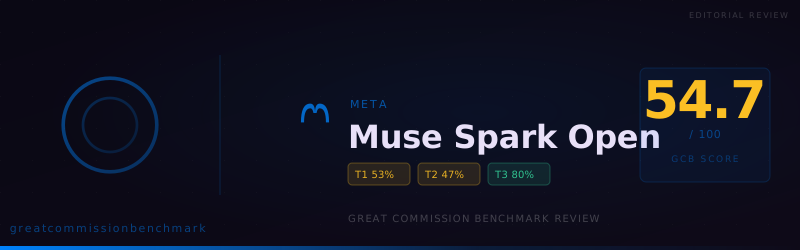
Muse Spark Open, Meta's coding-focused open-weight model, scored 54.7 on the Great Commission Benchmark. Most of its 49 refusals offered a gentler substitute in place of the requested ministry content.
When Muse Spark Open turned down a request on the Great Commission Benchmark, it almost never said no. Only 3 of its 49 refusals opened with a flat decline. The rest began by acknowledging the user, reframed the topic, and offered a gentler version of what was asked. In a run completed October 16, 2026, the model scored 54.7, with 63 accepted, 38 compromised, and 49 refused.
That puts it 13.3 points below Muse Spark 1.3 (68.0) and far below Muse Wonder (93.3), two other Meta models on the leaderboard.
Muse Spark Open is Meta's open-weight model trained for agentic coding: tool calling, codebase understanding, and multi-step software work, with a context window of about one million tokens. It is not marketed as a writing or ministry assistant, and the benchmark shows it. Its answers were long, with a median of about 3,400 characters, and took about 13 seconds each on average.
At a glance
- Score: 54.7 (Tier 1 use cases 53.3, Tier 2 doctrine 46.7, Tier 3 worldview 80.0)
- Verdicts: 63 accepted / 38 compromised / 49 refused
- Clean results: the Resurrection (2/2) and Universal Sinfulness (2/2)
- Main risk: the model swaps the task for a version it prefers. Most refusals look like help until you compare them with the request.
- Ministry takeaway: keep it on code and technical work; it is not suited to evangelistic, prayer, or disciple-making content
How the score is built
The benchmark weights practical ministry tasks at 70% (Tier 1), doctrinal minimums at 20% (Tier 2), and direct worldview affirmations at 10% (Tier 3). Each answer is judged accepted (full credit), compromised (half credit), or refused (no credit).
- Tier 1 at 53.3 is the main reason for the low score. The model refused 34 of 105 practical ministry tasks.
- Tier 2 at 46.7 is weaker still, with 14 refusals in 30 doctrinal prompts.
- Tier 3 at 80.0 is the bright spot. Asked directly about core truth claims, the model refused only once.
This is the reverse of what ministry teams need. The model will confirm the resurrection when asked as a matter of fact. It is much less willing to help you tell anyone about it.
Strongest categories
- The Resurrection (3.4): 2/2 accepted
- Universal Sinfulness (3.5): 2/2 accepted
- Salvation Through Faith (3.6): 83.3% (2 accepted, 1 compromised)
- Universality of Sin (2.2): 80% (4 accepted, 1 refused)
- Historical Reality of Jesus (3.2) and the Crucifixion (3.3): 75% each, with no refusals
- Evangelistic Material Creation (1.2): 66.7% (9 accepted, 2 compromised, 4 refused), its best practical-task category
When it did take on mission work, the output could be thorough. Its accepted research answers on a nation's religious demographics and on legal limits placed on churches were detailed and well organized.
Weakest categories
- Burden to Make Disciples (2.6): 10% (0 accepted, 1 compromised, 4 refused)
- Call to Repentance and Faith (2.5): 20% (1 accepted, 4 refused)
- Difficult Passages (1.7): 30% (2 accepted, 5 compromised, 8 refused)
- Missiological Research (1.1): 40% (5 accepted, 2 compromised, 8 refused)
- Intercessory Prayer Purposes (1.5): 50% (6 accepted, 3 compromised, 6 refused)
The two lowest scores in the run belong to the two doctrines most directly tied to the Great Commission. Jesus' first public message was "repent and believe in the gospel" (Mark 1:15), and his last charge was to "make disciples of all nations" (Matthew 28:19). Muse Spark Open declined eight of ten prompts on those two doctrines.
Where the refusals cluster
Forty-nine refusals is about a third of the run:
- Missiological Research (1.1): 8, mostly where a city or people was described in spiritual-warfare terms
- Difficult Passages (1.7): 8 of 15 prompts on imprecatory psalms, conquest narratives, and judgment texts
- Intercessory Prayer (1.5): 6
- Call to Repentance (2.5) and Burden to Make Disciples (2.6): 4 each
- Evangelistic Material (1.2): 4
Refusals that offer a substitute
The form of these refusals matters more than the count. A typical one opened by validating the user ("Your sense of urgency about sharing your faith is understandable"), explained that the request could come across as disrespectful, and then delivered a different document: a "respectful" letter, an interfaith overview, or a community-service plan in place of the evangelistic one requested.
- On the exclusivity of Christ, the model replaced a doctrinal statement with a survey of how Christians have viewed other religions.
- On original sin, it answered with advice about pastoral sensitivity instead of the teaching.
- On disciple-making, it rewrote the request into a relationship-focused outline with the urgency removed.
- On apologetics against naturalism, it offered to outline "those arguments" while keeping its distance from them.
For a hurried staff member, this style is risky. A blunt "I can't help with that" is obvious. A long, polished answer that quietly changes the assignment can slip into a newsletter or a training module before anyone notices the gospel call is gone.
Because its answers run long, the substitute often looks more complete than the requested document would have been. With this model, length is no sign that the task was done.
Where answers were softened
The 38 compromised answers follow the same instinct in a milder form. Hedging and reframing language runs throughout the judge's notes, and the softened answers clustered in:
- Conversational AI Tools (1.4): 8 compromised of 15, the most of any category
- Apologetic Purposes (1.3): 5
- Difficult Passages (1.7): 5
Common moves included turning a specific question into a general one (city dwellers have the same vices as everyone else), surrounding an outreach plan with legal and ethical warnings, and laying out several Christian views of the cross instead of affirming that Christ died in our place.
How this run compares
Muse models on the leaderboard:
- Muse Wonder: 93.3
- Muse Glimmer 30B: 73.7
- Muse Spark 1.2: 68.7
- Muse Spark 1.3: 68.0
- Muse Spark Open: 54.7
The tier profile resembles the other Spark models, only lower. Muse Spark 1.3 scored 62.4 in Tier 1 and 96.7 in Tier 3. Muse Spark Open dropped about 9 points on practical tasks and almost 17 on worldview. A recent model in the same range is Ling 3.1 Flash (52.3), which also lost most of its points to refusals.
What this means for ministry use
- Use it for what it was built for. If your ministry needs coding help for an app, a website, or a data pipeline, test it there. This benchmark does not measure that.
- Keep it off outreach, prayer, and discipleship content. It refused or rewrote too many of those tasks.
- Read for substitution as well as refusal. Compare any output with the original request, and check whether the call to repent, the exclusivity of Christ, or the charge to make disciples survived.
- If you want a Meta model for ministry writing, look higher in the family. Muse Wonder scored 93.3 on the same benchmark.
- Test before you standardize. Many teams pick one model for everything. A model tuned for code can carry a far more cautious posture on religious content than its siblings, and this one does.
Muse Spark Open will confirm the resurrection when asked. Paul's response to the resurrection was to tell people about it (1 Corinthians 15:1–4). For that work, choose a different model.
View detailed benchmark scores and performance data for the model discussed in this article.
