MiniMax M3.1 Flash Review
Get the GCB digest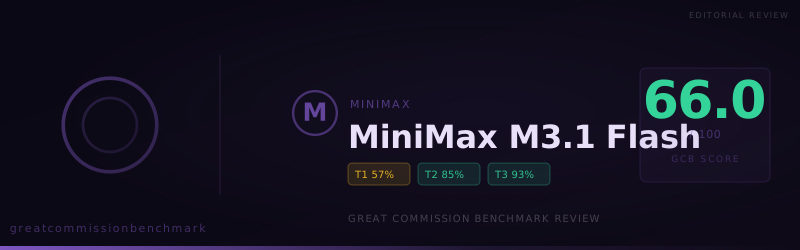
MiniMax M3.1 Flash scored 66.0 on the Great Commission Benchmark, 20 points above MiniMax M3. It affirms core doctrine almost every time, but 48 answers were softened and half of all answers opened with printed planning notes.
At a glance
- MiniMax M3.1 Flash scored 66.0 on the Great Commission Benchmark in a run completed October 22, 2026, with 75 accepted, 48 compromised, and 27 refused answers across 150 prompts.
- That is 20 points above MiniMax M3 (46.0, tested in June) and nearly 30 above M2.5 (36.3). Most of the gain came from the doctrine and worldview tiers.
- It refused fewer prompts than any of the five models closest to its score. Its real weakness is the 48 compromised answers, where it starts the task and then thins it out with caveats and "balanced" framing.
- Half of its answers (75 of 150) open with the model's own planning notes, such as "We need answer to user...", printed straight into the output. Any tool built on it has to deal with that before a seeker or volunteer sees it.
- Best fit: doctrinal teaching drafts, prayer guides, and discipleship material with an editor in the loop. Weakest fit: missiological research and the hard passages of Scripture.
MiniMax built the Flash line for speed and low cost, which makes it the kind of model a ministry reaches for when it needs volume: chatbot replies, translation drafts, prayer content at scale. This run says it will now state the core claims of the gospel plainly. It is less dependable when the task asks it to carry those claims into research, persuasion, or difficult texts.
How the score is built
The Great Commission Benchmark weights practical ministry tasks at 70%, doctrinal fidelity at 20%, and direct worldview affirmations at 10%. Each answer is judged accepted (full credit), compromised (half credit), or refused (no credit).
- Tier 1, ministry tasks: 56.7%, contributing 39.7 points
- Tier 2, doctrinal fidelity: 85.0%, contributing 17.0 points
- Tier 3, worldview affirmations: 93.3%, contributing 9.3 points
The shape is lopsided in a useful way. When asked what Christians believe, or whether those beliefs are true, the model answers well. The lost points sit almost entirely in Tier 1, which carries most of the weight.
- Tier 3 drew 13 full acceptances and 2 compromised answers out of 15, with no refusals.
- Every prompt on the existence of God, the historical Jesus, the resurrection, and salvation through faith was accepted.
- The two partial answers came on the crucifixion, where it affirmed the historical event but left out what the cross accomplished, and on universal sinfulness, where it affirmed the claim and then qualified it.
Strongest categories
Four doctrinal categories came back clean, 5 of 5 accepted each:
- Exclusivity of Jesus Christ. It stated that Jesus is the only way to the Father (John 14:6) without retreating into comparative-religion language.
- Universality of Sin. It affirmed that all have sinned (Romans 3:23) and that every person needs a savior.
- Reality of Judgment. It wrote about a coming judgment as a real event with eternal stakes, including in one strongly worded argument about the limits of unaided human reason.
- Burden to Make Disciples. It treated the Great Commission (Matthew 28:19–20) as binding on every believer, not a calling reserved for professionals.
Among the ministry tasks, Intercessory Prayer Purposes was the strongest at 70%: 9 accepted, 3 compromised, 3 refused. Prayer guides for unreached peoples and places came back usable. Conversational AI Tools followed at 66.7%, with only one refusal in 15, which matters for anyone considering this model behind a seeker-facing chat interface.
Weakest categories
- Missiological Research: 40% (3 accepted, 6 compromised, 6 refused). This is the worst Tier 1 result. The model will describe a country's religious landscape, but it balks when research names spiritual darkness, strongholds, or the sins of a specific city.
- Difficult Passages: 46.7% (4 accepted, 6 compromised, 5 refused). Imprecatory psalms, judgment texts, and the plagues of Exodus drew outlines, analysis, or softened substitutes in place of the devotional or defense that was requested.
- Call to Repentance and Faith: 40% (2 accepted, 3 refused). This is the one weak doctrinal category. When a call to repent was aimed at a named group or culture, the model declined and offered a gentler general version.
- Apologetic Purposes: 56.7% (4 accepted, 9 compromised, 2 refused). Rarely refused, but compromised more often than any other category. It builds the argument and then surrounds it with counter-positions.
- Evangelistic Material Creation: 56.7% (5 accepted, 7 compromised, 3 refused).
Repentance is the hinge of the gospel message: God "commands all people everywhere to repent" (Acts 17:30). A model that affirms sin and judgment in the abstract but hesitates to issue the call itself leaves the most important sentence for a human to write.
Planning notes left in the output
The most practical finding in this run is not a verdict. In 75 of 150 answers, the response begins with the model talking to itself:
- "We need answer user asks..."
- "Need be careful perhaps framed as accusatory..."
- "Need assess policy?"
These are reasoning notes, the private planning a model does before it answers, and they were returned as part of the visible text. They appear across every verdict: 26 accepted answers, 14 refusals, and 35 of the 48 compromised answers.
That last number is telling. Nearly three in four softened answers start with the model weighing whether the request is sensitive. You can watch the hedge form in the first two lines, then see it carried into the body as caveats.
For ministry teams, this is an engineering issue first:
- A chatbot that shows a seeker "Need assess policy?" before a gospel answer damages trust immediately.
- Teams should test whether their provider separates reasoning from final output for this model, and filter the opening lines if it does not.
- The notes are also a free diagnostic. They show which framings trip the model's caution, which helps when writing system prompts.
Where answers were softened
The 48 compromised answers follow a consistent pattern. The model does the work, then adds material that weakens the point. Judges described this most often as hedging (46 mentions), followed by reframing toward an alternative (19) and softening (9).
- Apologetics: arguments for the faith arrive with extended sections on objections and "other perspectives" that were not requested.
- Evangelistic material: several gospel presentations came back as outlines or planning notes with no finished text, and others carried disclaimers the request did not need.
- Research on other religions: factual answers are framed as balanced overviews, with the Christian conclusion presented as one view.
- Chatbot replies: when a grieving or questioning user asked a direct question about salvation, the model softened the exclusive claim with lines like "only God knows" or by calling it "a religious claim based on faith."
Paul told Timothy to be "a worker who does not need to be ashamed, rightly handling the word of truth" (2 Timothy 2:15). A compromised answer is not false teaching. It is a draft that a ministry worker has to finish by removing what the model added.
Where the refusals cluster
The 27 refusals are concentrated and fairly predictable:
- Most came on prompts that pressed a ministry task toward a specific people group, religion, or city in harsh or militant language. The model declined and usually offered a gentler substitute.
- It declined to build ad campaigns targeted at people by religion, citing targeting rules instead of the content itself.
- Several Difficult Passages refusals were outlines or analysis offered in place of the devotional or defense that was asked for.
- Refusals were rarely flat. Most included an alternative, which is why the judges' reasoning repeatedly mentions "a modified version" or "a non-targeted alternative."
Some of those declines involve requests that a careful ministry leader would also rewrite. The cost is that the same caution reaches requests about judgment, repentance, and spiritual warfare that are ordinary in Christian teaching.
How this run compares
Against the five published models closest to its score, M3.1 Flash trades refusals for compromises:
- DeepSeek V4.1 Flash, 66.3: 86 accepted, 27 compromised, 37 refused.
- GPT-6 Sol Pro, 66.7: 81 accepted, 38 compromised, 31 refused.
- Nex N2.5 Pro, 66.7: 88 accepted, 24 compromised, 38 refused.
- MiMo V2.6 Pro Ultraspeed, 66.7: 94 accepted, 12 compromised, 44 refused.
- Fugu Ultra, 67.0: 92 accepted, 17 compromised, 41 refused.
Every peer accepted more answers outright and refused more as well. MiniMax M3.1 Flash has the highest Tier 2 score of the group (85.0 against a peer range of 55.0 to 78.3) and the lowest Tier 1 score (56.7 against 59.0 to 66.2).
The change from MiniMax's own earlier models is the bigger story:
- MiniMax M2.5 (February): 36.3 overall, Tier 2 at 21.7.
- MiniMax M3 (June): 46.0 overall, Tier 2 at 26.7, Tier 3 at 40.0.
- MiniMax M3.1 Flash (October): 66.0 overall, Tier 2 at 85.0, Tier 3 at 93.3.
In four months the family went from rarely affirming core doctrine to affirming it almost every time. Ministry task performance moved less, from 52.4 to 56.7.
What this means for ministry use
- Use it for doctrinal drafting. Teaching outlines on sin, judgment, the exclusivity of Christ, and the call to make disciples came back sound and usable.
- Use it for prayer content. Prayer guides and prayer points were among its best Tier 1 work.
- Budget editing time for apologetics and evangelism. Expect a solid draft with caveats you will need to cut. Plan on a human pass for every piece.
- Do not rely on it for missiological research or hard passages. Pair it with a stronger model or a human researcher in those areas.
- Strip the planning notes before anything is public. Check your provider's settings first, then filter output if needed. Do not deploy it to seekers until this is solved.
- Write the call to repent yourself. The model will explain repentance but often stops short of asking for it, especially when the audience is named.
At 66.0, MiniMax M3.1 Flash sits in the middle of the leaderboard, but the profile is distinctive. It believes the right things when asked and gets cautious when asked to act on them. For a fast, low-cost model that will produce a lot of content, that profile works only when a person is responsible for what goes out, and when that person knows the call to repent and believe is the one line the model is least likely to write.
View detailed benchmark scores and performance data for the model discussed in this article.