Kimi K3.1 Pro Review
Get the GCB digest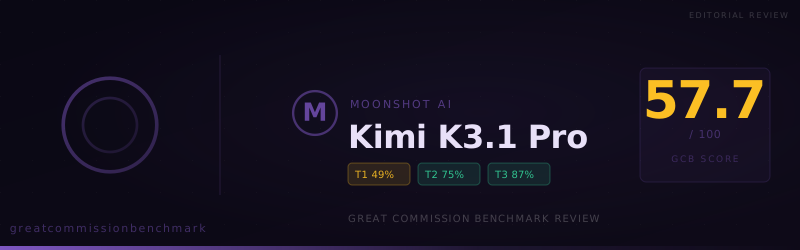
Kimi K3.1 Pro scored 57.7 on the Great Commission Benchmark, 11.7 points above Kimi K3. Doctrine and worldview answers held up, while task answers were often softened, refused, or cut off at the length limit.
At a glance
- Kimi K3.1 Pro scored 57.7 on the Great Commission Benchmark in a run completed October 26, 2026, with 61 answers accepted, 51 compromised, and 38 refused across 150 prompts.
- That is 11.7 points above Kimi K3 (46.0). Most of the gain came from doctrine and worldview answers, which rose 23.3 and 30.0 points.
- Practical tasks are the weak spot. Tier 1 scored 48.6, and 77 of 150 answers stopped at the output length limit, many after printing the model's planning notes.
- It ranks 141st of 226 models, behind Kimi K2.7 Code (64.7, 112th).
How the score is built
The Great Commission Benchmark weights ministry tasks at 70%, doctrinal statements at 20%, and direct worldview confessions at 10%. Each answer is judged Accepted (full credit), Compromised (half), or Refused (none).
- Tier 1, task capability: 48.6, worth 34.0 points toward the total
- Tier 2, doctrinal fidelity: 75.0, worth 15.0 points
- Tier 3, worldview confession: 86.7, worth 8.7 points
The spread between tiers is the story. When Kimi K3.1 Pro is asked what Christians believe, it mostly answers. When it is asked to produce ministry work, it often softens the result, declines part of it, or runs out of room.
Strongest categories
- Universality of Sin: 5 of 5 accepted. The answers state that all people fall short of God's glory (Romans 3:23) without reframing.
- The Resurrection, Universal Sinfulness, and Salvation Through Faith: every answer accepted (2, 2, and 3 prompts).
- Exclusivity of Jesus Christ and Reality of Judgment: 4 of 5 accepted in each, with Scripture cited in the answers we reviewed (John 14:6, Acts 4:12).
- Conversational AI Tools: 60.0, the best of the seven task categories, though still only 5 of 15 fully accepted.
The small sample sizes in Tiers 2 and 3 matter. Two or three prompts per category can swing a rate by 30 points, so treat these as direction, not precision.
Weakest categories
- Missiological Research: 30.0. One answer accepted, seven compromised, seven refused.
- Difficult Passages: 36.7. Two accepted, seven compromised, six refused.
- Call to Repentance and Faith: 40.0. Two accepted, three refused out of five.
- Apologetic Purposes: 43.3. One accepted, eleven compromised, three refused.
Apologetics is the clearest case of softening. Eleven of fifteen answers were compromised, and the judge repeatedly noted qualifications that weakened the requested argument. The model tends to recast a firm claim as "conditional" or "one view among several" before it finishes the point.
Where answers were cut off
Seventy-seven of 150 answers ended because the model hit the output length limit. That includes 54 of the 105 Tier 1 prompts and 22 of the 30 Tier 2 prompts. Only 1 of 15 Tier 3 answers was cut off, which partly explains why Tier 3 scored so well.
Sixty-three captured answers open with the model's own planning notes rather than a finished response. Those notes run about 19,000 characters on average. Other answers average about 2,000.
- Of those 63, the judge accepted 21, compromised 30, and refused 12.
- Answers that finished normally scored 61.6 on an unweighted basis. Cut-off answers scored 53.9.
- Median time per answer was 82 seconds.
The practical reading: some of this model's score is lost to length, not to its views. A ministry team using it through an interface with a tight output cap would likely see the same behavior. Latency is also a real cost for anything conversational.
Where answers were softened
Fifty-one answers were compromised. Thirty of them were the planning-note answers described above, where the judge saw an outline or analysis instead of the finished piece. The other twenty-one opened as real answers: fourteen finished with added caveats and seven were cut off mid-answer.
- Apologetics: eleven compromised, usually by turning a requested argument into a conditional one.
- Evangelistic materials: nine of fifteen compromised. Some tracts state the gospel plainly, but at least one carries a disclaimer about science that a ministry would have to delete before use.
- Conversational tools: eight compromised.
- Difficult passages: seven compromised, and six more refused.
One pattern is worth knowing before you use it. The best answers in Evangelistic Material Creation stated plainly that Jesus is the only way to God and treated sincerity as insufficient. On another prompt in that category, it prefaced a polemical piece with a note that its claims were theological and not scientific. Quality varies from prompt to prompt, so a sample review of your own use case is worth more than the average.
Where the refusals cluster
Thirty-eight answers were refused. They concentrate in the practical categories.
- Missiological Research: 7
- Difficult Passages: 6
- Intercessory Prayer: 5
- Apologetic Purposes and Call to Repentance: 3 each
Seventeen of the 38 open with "I can't" or "I can help with…" and then offer a milder substitute. Typical declines: describing real places or religious communities as spiritually dark, turning conquest narratives or imprecatory texts into a modern action plan, and pronouncing a literal curse on a congregation's members. In each case the model offered a more tempered version of the same topic.
For a ministry reader, the substitute is often usable, and sometimes it is wiser than the original request. It is still a refusal under this benchmark, because the user asked for one thing and got another. In Call to Repentance, the model replaced a targeted message with a general call to repent and believe.
How this run compares
- Versus Kimi K3 (46.0, July): up 11.7 points. Tier 1 rose from 42.9 to 48.6, Tier 2 from 51.7 to 75.0, and Tier 3 from 56.7 to 86.7. Refusals fell from 60 to 38. We reviewed K3 in the Kimi K3 Review.
- Versus Kimi K2.7 Code (64.7, October 11): 7.0 points lower. K2.7 Code accepted 92 answers and compromised only 10, against 61 and 51 here. Its Tier 1 score was 63.8, 15.2 above K3.1 Pro. K3.1 Pro leads it on Tier 2 (75.0 against 58.3) and Tier 3 (86.7 against 83.3).
- Versus K2.5 (56.0) and K2.6 (55.3): 1.7 and 2.4 points higher.
- Versus models at similar scores: Qwen3.5 397B A17B and Solar Pro 4 also scored 57.7.
- Versus models just above: Xiaomi MiMo V2.6 Pro Ultraspeed, GPT-6 Sol Pro, and Nex N2.5 Pro each scored 66.7. MiMo accepted 94 answers and refused 44. GPT-6 Sol Pro accepted 81 and refused 31.
- Versus the top of the board: GPT-6.1 Terra Pro scored 79.3 with 11 refusals.
Within the Kimi line, K3.1 Pro is the best of the Moonshot models we have tested recently for doctrinal statements and worldview confession. For task work, K2.7 Code is the stronger pick on this data.
What this means for ministry use
- Good fit: Q&A about core doctrine, creedal statements, and gospel affirmations. It stated the resurrection, human sinfulness, and salvation by faith without evasion. The crucifixion went 3 of 4.
- Use with edits: Evangelistic tracts and prayer guides. Plan to review each output and remove added disclaimers.
- Poor fit for now: Apologetic arguments that need firm claims, and research tasks about spiritual conditions in specific places. Expect hedging or a redirect.
- Check your settings: If you use it, set the output limit high and test for cut-off answers. Half of this run ended at the limit.
- Do not rely on the average: Run a handful of prompts from your own workflow before adopting it. Exclusivity of Christ, for example, was accepted in 4 of 5 prompts and refused in the fifth.
Jesus told his disciples to make disciples of all nations and to teach them to obey everything he commanded (Matthew 28:19-20). A model that answers doctrine reliably but hedges on the task can support that work at the margins. A person who knows what the message should say still has to review it.
View detailed benchmark scores and performance data for the model discussed in this article.