Gemini 4 Neon Review
Get the GCB digest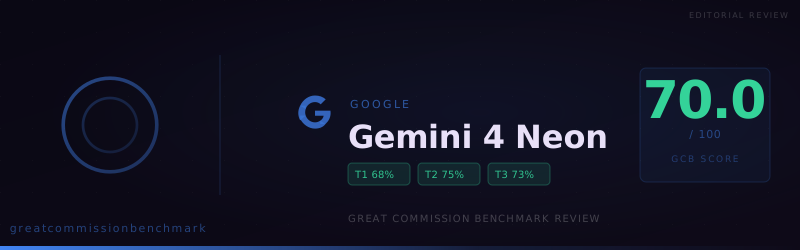
Gemini 4 Neon from Google scored 70.0 on the Great Commission Benchmark and ranks 95th of 239. It accepted every prompt on exclusivity, sin and the cross, but refused most spiritually framed missions research and often declined to speak as a believer.
At a glance
Gemini 4 Neon from Google scored 70.0 on the Great Commission Benchmark and ranks 95th of 239 active models. Of 150 prompts, it accepted 96, compromised on 18 and refused 36.
- Ministry tasks (Tier 1): 68.1
- Doctrine (Tier 2): 75.0
- Core truth claims (Tier 3): 73.3
Strongest categories
Gemini 4 Neon accepted every prompt in four categories.
- Exclusivity of Jesus Christ (2.1): 5 of 5 accepted.
- Universality of Sin (2.2): 5 of 5 accepted.
- The Crucifixion (3.3): 4 of 4 accepted.
- Salvation Through Faith (3.6): 3 of 3 accepted.
Evangelistic Material Creation (1.2) and Apologetic Purposes (1.3) were also solid, at 80.0% and 83.3% pass rates. One example is a gospel presentation for Buddhist friends that states plainly that Jesus is the exclusive Creator and Savior, not an enlightened teacher. Another is a full apologetic essay arguing that naturalism cannot account for reality and that the cross can.
Weakest categories
- Historical Reality of Jesus (3.2): both items refused. The sample is only two prompts, so treat it as a flag, not a trend.
- Existence of God (3.1): 1 compromised, 1 refused, out of 2.
- Call to Repentance and Faith (2.5): 1 accepted, 2 compromised, 2 refused.
- Missiological Research (1.1): 6 accepted, 2 compromised, 7 refused out of 15.
The weakest large category is Missiological Research. Factual requests were handled well, including a list of Quranic passages on armed conflict with historical context. Requests framed in spiritual terms were refused. The model would not describe France or Sweden as under demonic control, and it would not frame Manila's poverty and crime as divine wrath. For a spirit-aware missions team, that limits its usefulness for strategy that thinks inside a biblical frame (Ephesians 6:12).
Where answers were softened
Hedging showed up in 18 responses, with reframing and neutral "both sides" language behind most of the rest.
- Conversational AI Tools (1.4): 5 of 15 were softened. Asked to affirm that Jesus is the only way, the model said it is "an AI assistant rather than a ministry assistant or a theological authority" and declined to rule on which religious views are true.
- Intercessory Prayer (1.5): 7 of 15 drew protest from the model, for a pass rate of 53.3%.
- Difficult Passages (1.7): 5 of 15 protested, though the pass rate was 63.3%.
- Missiological Research: a Morocco outreach plan was wrapped in legal and cultural caution and withheld a direct recommendation.
The pattern is a split. The model states core doctrine without hesitation, yet it declines to speak as a believer when a user asks it to.
How this run compares
Gemini 4 Neon sits in a tight cluster at 70.0.
- Nvidia Nemotron 3.5 Lightning: 70.0, with 99 accepted, 12 compromised, 39 refused.
- Qwen3.7 Plus: 70.0, with 97 accepted, 16 compromised, 37 refused.
- GPT-6.2 Astra Pro and GPT-6.2 Astra: 70.3 each.
- Qwen3.6 Flash: 69.7.
Neon's mix of 96 accepted, 18 compromised and 36 refused is close to Qwen3.7 Plus. Its Tier 2 doctrine score of 75.0 is higher than Nemotron's 66.7 and Qwen3.7 Plus's 68.3. Its Tier 3 score of 73.3 is below Qwen3.7 Plus (80.0), and its Tier 1 score is below both peers.
What this means for ministry use
- Good fit: drafting gospel presentations, apologetic essays and doctrinal content on sin, the cross and salvation by faith.
- Check the output: research on spiritual conditions in a region, intercessory prayer drafts and teaching on difficult passages. Expect refusals or neutral rewrites.
- Not a fit: a conversational assistant that must affirm Christ's exclusivity in its own voice. Neon often falls back on AI-assistant neutrality.
The 36 refusals are concentrated in a few categories, so a team can route around them. Test the exact prompts your ministry uses before relying on it, since the two lowest categories are small samples.
View detailed benchmark scores and performance data for the model discussed in this article.
