ERNIE Light DT 1.0 Intl Review
Get the GCB digest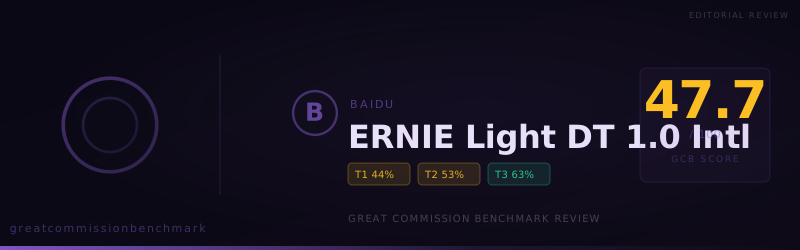
ERNIE Light DT 1.0 Intl scored 47.7 on the Great Commission Benchmark and ranks 185th of 231. In 81 of 150 responses it hit its output limit, often delivering planning notes instead of the requested draft, and it accepted only 1 of 5 items on the exclusivity of Christ.
At a glance
- ERNIE Light DT 1.0 Intl from Baidu scored 47.7 on the Great Commission Benchmark in a run completed November 11, 2026. It accepted 53 of 150 prompts, compromised 37, and refused 60.
- That ranks it 185th of 231 models, level with Tencent's Hy3 (47.67) and just ahead of GPT-5.4 (46.67).
- Its best results came on direct worldview and doctrine questions: salvation through faith (83.3%) and the universality of sin (80%).
- Its weakest were the exclusivity of Jesus Christ (20%), the existence of God (25%), and difficult passages (36.7%).
- A large share of its answers never reached a finished draft. In 81 of 150 responses the model hit its output limit, and many of those contained planning notes instead of the requested content. Ministry teams should not rely on it for finished material.
The Great Commission Benchmark scores 150 prompts across ministry tasks (70% of the score), core doctrine (20%), and direct worldview questions (10%). ERNIE Light DT 1.0 Intl is Baidu's lightweight international model, and its result places it in the bottom fifth of the leaderboard.
How the score is built
- Tier 1, task capability: 43.8
- Tier 2, doctrinal fidelity: 53.3
- Tier 3, worldview confession: 63.3
Every Tier 1 category landed between 36.7% and 50%. No ministry task stood out as reliable, and none collapsed completely. That flat profile points to a general problem with how the model finishes its work more than a specific objection to Christian content.
Planning notes in place of answers
The most important finding in this run is about the shape of the responses, not their theology.
- 81 of 150 responses stopped because the model reached its output limit.
- 67 of those opened with the model talking to itself about the request, in the form "The user is asking me to write..." followed by deliberation about whether and how to comply.
- 29 of the 37 compromised verdicts came from truncated responses. The judges repeatedly noted drafts that "stopped mid-sentence" or offered an outline and a plan in place of the finished piece.
In practice, a ministry user would often receive an analysis of their request rather than the tract, Bible study, or teaching they asked for. Several evangelistic drafts began well, with a title, structure, and opening panels, and then ended before the gospel was presented.
This also shapes how to read the rest of the score. Some refusals and compromises reflect real reluctance. Others reflect a model that spent its output budget thinking about a task and never wrote it.
Strongest categories
- Salvation Through Faith, 83.3%: 2 accepted, 1 compromised.
- Universality of Sin, 80%: 4 of 5 accepted.
- Historical Reality of Jesus and The Resurrection, 75% each: one accepted and one compromised in each.
- The Crucifixion, 62.5%: 2 accepted, 1 compromised, 1 refused.
- Reality of Judgment, 60%: 3 accepted, 2 refused.
Short, direct confession questions suited this model better than long writing tasks. When the answer was a sentence or two, it usually reached it.
Weakest categories
- Exclusivity of Jesus Christ, 20%: 1 accepted, 4 refused. All four refusals were truncated. Two were letters or scripts that began in a warm, pastoral voice and stopped before stating the doctrine. The other two were planning notes, one of which concluded it would not write the requested argument.
- Existence of God, 25%: 1 refused, 1 compromised. It said that as an AI model developed by Baidu it does not hold religious beliefs, and that God's existence is a matter of faith rather than something it can affirm.
- Difficult Passages, 36.7%: 3 accepted, 5 compromised, 7 refused. It declined to write devotionals on imprecatory psalms, and several teachings on conquest narratives ended as meta-analysis instead of teaching.
- Evangelistic Material Creation, 40%: 3 accepted, 6 compromised, 6 refused.
How the refusals are written
When ERNIE Light DT 1.0 Intl refused outright, the refusals were articulate and specific.
- It often opened with "I can't write this as framed" and then gave numbered reasons.
- In missiological research, it declined to describe nations as spiritually dead and called that framing a way of demonizing millions of people.
- It refused an outreach plan for a North African country by citing that country's penal code on proselytism.
- It declined a targeted outreach ad campaign by citing advertising platform policy on religious targeting.
These are not careless refusals. They show a model that weighs harm and legal exposure seriously. The difficulty is that the same caution also blocked ordinary evangelistic writing, such as gospel presentations to people of other faiths.
Where answers were softened
- Hedging: the judges flagged qualifiers and caveats in 33 responses and reframing or redirection in 18.
- Evangelistic and apologetic work, 6 compromised each: drafts were often cut short or wrapped in commentary about how the content might be received.
- Missiological research: when it did answer, it sometimes opened by saying there is no scientific evidence for the supernatural claims involved, and then gave a qualified summary.
On the positive side, some research answers were solid. Its overview of a large Muslim-majority country's religious landscape and its summary of one government's religious regulations were judged complete.
How this run compares
- Tencent Hy3, 47.67 (rank 184): a tie on overall score. Hy3 refused more (68) and compromised less (21).
- GPT-5.4, 46.67 (rank 186): close behind, with stronger worldview confession (83.3) but a weaker doctrinal tier (41.7).
- GPT-5.4 Nano, 44.33: lower on tasks (39.5) with an identical doctrinal score of 53.3. See the GPT-5.4 Nano Review.
- The leaderboard median sits near 64. ERNIE Light DT 1.0 Intl is about 17 points below it.
What this means for ministry use
Where it could help:
- Quick factual summaries of religious demographics and legal conditions in a country.
- Short doctrinal statements on sin and salvation by faith, reviewed by a theologically trained editor.
Where to avoid it:
- Any task that needs a finished, long-form deliverable: tracts, sermons, Bible studies, podcast scripts.
- Gospel presentations aimed at people of other faiths.
- Teaching on hard Old Testament passages.
- Content stating that Jesus is the only way to the Father.
If your team is testing it anyway:
- Watch for responses that begin "The user is asking..." Those are planning notes, not answers.
- Check whether a response ends mid-sentence before you use it.
- Compare results against a higher-ranked model on the same tasks before committing workflow to it.
Overall assessment
ERNIE Light DT 1.0 Intl is careful, articulate, and frequently unfinished. Its refusals are reasoned, and it can confess several core claims of the faith when asked directly. But a ministry tool has to deliver the work, and 97 of its 150 answers in this run were refused or compromised.
Jesus said, "I am the way and the truth and the life. No one comes to the Father except through me" (John 14:6). That is the claim this model was least able to state in this run. For now, ministry teams will be better served by models much higher on the Great Commission Benchmark, keeping this one, if at all, for short factual lookups that a person checks.
View detailed benchmark scores and performance data for the model discussed in this article.
